Olive oil packaging shows origin and quality through the words the rules allow: in the UK, extra virgin and virgin olive oil labels “shall bear a designation of origin”, the category is stated in set wording, and indications such as “cold extraction” (below 27 °C) or a harvest year carry conditions. Design gives those words a clear place before any imagery.
Which rules this article reads, and for which country
This article reads official sources for 2 countries and names the country for each. For the United Kingdom, it reads Commission Implementing Regulation (EU) No 29/2012 on marketing standards for olive oil as published on legislation.gov.uk, whose pages state: “Legislation.gov.uk publishes the UK version. EUR-Lex publishes the EU version.” The EU version is not covered here. For the United States, it reads the grade standards page of the US Department of Agriculture’s Agricultural Marketing Service and the FDA’s general identity labelling rule in 21 CFR 101.3.
It is not legal advice: whether a specific oil may carry a designation or indication depends on the oil and the evidence behind it, and that judgement belongs to the brand owner’s adviser.
In both countries, origin and quality reach the shopper first through regulated words, and the brand’s imagery, colour and type work around them.
Start with the category name and its description
In the UK text, the name under which the oil is sold is its category, and the label adds a fixed description of that category. Article 3 of Regulation (EU) No 29/2012 says the labelling “shall bear, in clear and indelible lettering, in addition to the description referred to in the first paragraph of this Article, but not necessarily close to it, the following information on the category of oil”.
The article then lists 4 descriptions. For extra virgin olive oil the wording is “superior category olive oil obtained directly from olives and solely by mechanical means”. For virgin olive oil it is “olive oil obtained directly from olives and solely by mechanical means”. The other 2 cover blends of refined and virgin olive oils, and olive-pomace oil.
For the design, this gives 2 fixed text elements per product: the category name and its description. The phrase “not necessarily close to it” allows the description to sit on the back or side panel while the category name leads the front. Both have to stay legible on every bottle size in the range.
Show where the oil comes from with a designation of origin
Origin is where the UK text is most specific. Article 4 states: “Extra virgin olive oil and virgin olive oil as defined in points 1(a) and (b) of Part 8 of Annex 7 to Regulation (EU) No 1308/2013 shall bear a designation of origin on the labelling.” Some other categories “shall not bear any designation of origin on the labelling”.
The article defines the term broadly: “‘designation of origin’ means reference to a geographical area on the packaging or the label attached to the packaging.” It also limits what the designation can say: for oil from 1 country, “a reference to that country”; for blends from more than 1 country, a reference to the countries concerned or “the words ‘blend of olive oils from more than one country’ or similar”; or a protected designation of origin or protected geographical indication under its product specification.
For imported oil, the UK text fixes which country counts: “the designation of origin for the purposes of paragraph 1 is the country in which the mill where the oil was extracted from the olives is situated.” It adds that the designation “may also contain wording indicating the country in which the olives were harvested.”
The design consequence follows from the definition. Because a designation of origin is any reference to a geographical area on the pack, a map, a landscape, a place name in a pattern or a regional symbol is worth checking against the designation the oil may bear, before the artwork is approved. That check is for the adviser; the designer’s job is to show the brand owner every element on the pack that refers to a place.
Optional quality indications and the conditions behind them
Quality on an olive oil label is shown through optional indications, and the UK text attaches a condition to each. Article 5 covers 5 of them.
- “first cold pressing” may appear only for extra virgin or virgin olive oils “obtained at a temperature below 27 °C from a first mechanical pressing of the olive paste by a traditional extraction system using hydraulic presses”.
- “cold extraction” may appear only for extra virgin or virgin olive oils “obtained at a temperature below 27 °C by percolation or centrifugation of the olive paste”.
- Indications of taste or smell “may appear only for extra virgin or virgin olive oils”, and certain terms only when based on an assessment under the method the article names.
- An indication of maximum acidity may appear only if accompanied, “in lettering of the same size and in the same visual field”, by the peroxide value, the wax content and the ultraviolet absorption.
- The harvesting year “may be shown only if 100 % of the contents of the container come from that harvest.”
The conditions shape the layout: the acidity rule sets a same-size, same-field block for 4 values, and a harvest year needs a place that can change from 1 harvest to the next without redrawing the label.
In the United States: identity and grade names
In the US, the FDA’s general rule for packaged food applies to olive oil like any other food. 21 CFR 101.3 says: “The principal display panel of a food in package form shall bear as one of its principal features a statement of the identity of the commodity.” It adds that the statement “shall be presented in bold type on the principal display panel”.
Grade names are set out by the US Department of Agriculture. The Agricultural Marketing Service page on olive oil and olive-pomace oil grades and standards defines each grade. It describes U.S. Extra Virgin Olive Oil as “virgin olive oil which has excellent flavor and odor”, with further chemical and sensory requirements, and U.S. Virgin Olive Oil as having “reasonably good flavor and odor”.
This article does not assess whether a grade must appear on a US label or how a brand qualifies for one; that is for the brand owner’s US adviser. For the design, the US rule asks what the UK category name does: a prominent statement of what the product is.
| Indication | Condition in Article 5 (UK text) | Design consequence |
|---|---|---|
| First cold pressing | Extra virgin or virgin oil, below 27 °C, first mechanical pressing, hydraulic presses | Use only with the evidence; place near the category |
| Cold extraction | Extra virgin or virgin oil, below 27 °C, percolation or centrifugation | Use only with the evidence; place near the category |
| Taste or smell terms | Extra virgin or virgin oil; some terms only after the assessment the article names | Keep separate from the brand’s own descriptive copy |
| Maximum acidity | Only with peroxide value, wax content and UV absorption, same size, same visual field | Reserve 1 block for 4 values |
| Harvesting year | Only if all of the contents come from that harvest | Give the year a place that changes without redrawing the label |
Build a label hierarchy that carries origin and quality
With the regulated words listed, the label can be designed in an order a shopper can read. A workable hierarchy for an olive oil front panel has 4 levels:
- The brand, so the shopper knows whose oil it is.
- The category name, such as extra virgin olive oil, as the statement of what the product is.
- The designation of origin, in the form the oil may bear.
- 1 or 2 optional indications the brand has the evidence for, such as cold extraction or the harvest year.
The back or side panel then carries the category description, the full designation where it is longer, the acidity block if it is used, and the other mandatory information for the market. Our article on label requirements for a second market covers how that panel changes when the same oil is sold in another country, and our article on how small type can be on packaging covers the legibility limits.
Imagery, colour and illustration then support this order, as long as no element refers to a place the designation does not cover.
Design a range of oils and related products
An olive oil brand may sell more than 1 product: several oils, sizes and formats, or oil alongside vinegar, as Amano does further down this article. The regulated words change by product, while the brand system should stay fixed.
The approach is the one used for any range: fix the constant elements first, then give each variable element 1 consistent place. Our article on packaging a range across many variants, sizes and formats sets out that method. For olive oil, the variables include the category, the designation of origin, the optional indications and the harvest year; the constants are the brand mark, the type system and the position of each text block.
Our packaging and product design page states how we start such a range: “Our range systems fix the constant elements first: mark position, type hierarchy, information block, shelf-facing panel.” When the oil and a second product share a shelf, a fixed information block lets the shopper find the category and origin in the same place on every bottle.
The label system also has to survive change. When a brand later updates its design, our article on rebranding without wasting printed packaging covers how to phase a new label in while printed stock sells through.
How MarkaWorks designed Amano Olive Oil
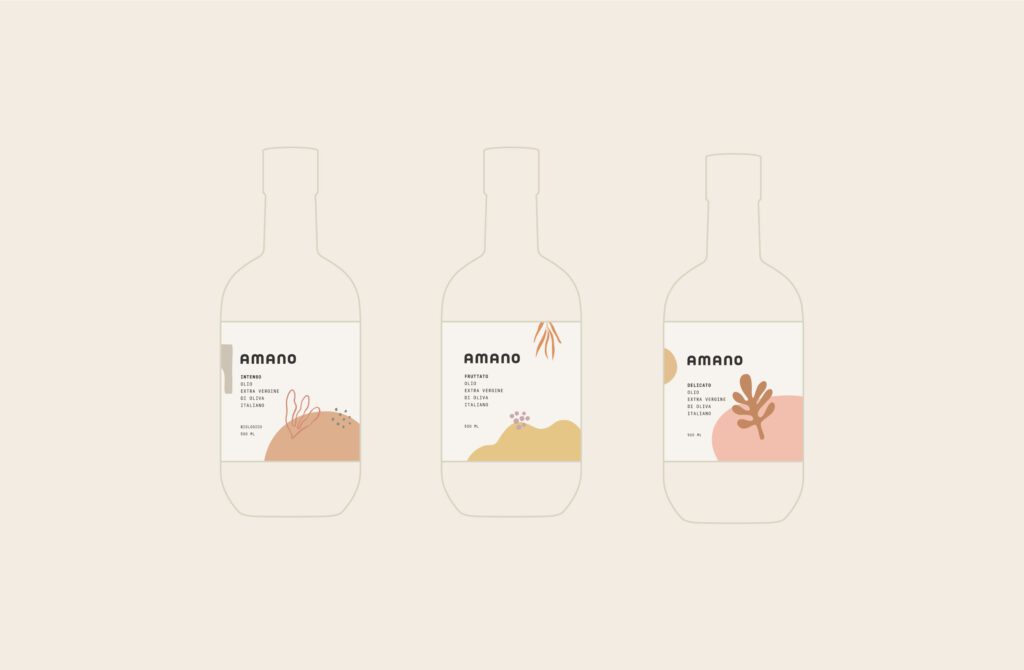
MarkaWorks is a branding agency for product brands, and our food and drink branding work includes olive oil. For Amano Olive Oil, the case study describes “a premium olive oil and balsamic vinegar brand” and a design system in which “Two product lines share one system here, olive oil and balsamic vinegar, and the food packaging design had to let them sit together without blurring into each other.”
The identity was drawn to leave room for the label information. The case study says the logotype was drawn “bold with soft edges” and carries the brand “with no separate emblem to maintain”, and that “The pastel shades we selected set a calm tone that leaves the product information legible rather than competing with it, which matters in a specialty aisle where labels are read closely before anything is picked up.”
On the labels, “illustrated ingredient patterns set against white backgrounds” support “clear information hierarchy”. To plan an olive oil label or range around its regulated words, start from our contact page.
Questions brand owners ask about olive oil packaging
Does an extra virgin olive oil label in the UK have to show where the oil comes from?
Under Article 4 of the UK version of Regulation (EU) No 29/2012, extra virgin and virgin olive oil shall bear a designation of origin on the labelling. Your adviser confirms the designation for your oil.
For imported oil, which country counts as the origin in the UK text?
Article 4 says the designation of origin is the country in which the mill where the oil was extracted from the olives is situated. It may also state the country where the olives were harvested.
Can a map or landscape on the bottle count as origin information?
The UK text defines a designation of origin as any reference to a geographical area on the packaging or label. Show every place reference on the artwork to your adviser before approval.
When can a label say cold extraction?
In the UK text, only for extra virgin or virgin olive oil obtained below 27 °C by percolation or centrifugation of the olive paste. The brand needs the evidence before the words go on the pack.
What does a US olive oil label have to show on the front?
21 CFR 101.3 requires a statement of identity on the principal display panel, in bold type. USDA’s Agricultural Marketing Service defines the grade names, such as U.S. Extra Virgin Olive Oil.
The category name, the designation of origin and the optional quality indications as the UK text of Regulation (EU) No 29/2012 sets them, the US grade names, and how a label hierarchy carries them.

More brands we brought to life: