What each format gives the design: 360 degrees of print or a label panel, how each reads in a cooler, where the barcode sits, and what the rules in 2 markets ask of the container.
Choose the format by answering 3 questions before any artwork: which surface carries the design, where the drink will be seen, and which rules apply in your markets. A can gives print all the way round, 360 degrees, and a bottle gives a label panel and a shape. In England and Northern Ireland, aluminium cans of 150 millilitres to 3 litres carry a deposit from 1 October 2027.
What the format decides before any artwork
Can or bottle is a structural choice, and it comes before the design. The format fixes the surface we draw on, the place where the shopper meets the drink and the rules the pack falls under.
Answer 3 questions before the first sketch:
- Which surface carries the brand: print around the whole container, or a label on part of it?
- Where will most people first see the drink: an ambient shelf, a cooler door, an ice bucket or a product page?
- Which markets will it be sold in during the first 2 years, and what do they require of the container?
Either format can carry a strong identity, and the sources cited below name no winner. They do give facts that differ by material, and the table sets them side by side.
Some answers sit with your producer. How the drink keeps in each container, what the filling line can run and what each format costs to make are questions for the producer or co-packer. Tea brands face a similar choice between a tin, a pouch and a box, and our guide to packaging for loose leaf tea works through what each of those formats does.
| Point | Can | Bottle |
|---|---|---|
| Printable surface | The whole wall of the container, 360 degrees | A label panel, with the glass or plastic, the neck and the cap around it |
| Barcode position for items scanned at checkout (GS1 US) | Lower right-hand section of the back; the artwork has to define which side is the back | Lower right-hand section of the back label |
| Deposit Return Scheme in England and Northern Ireland from 1 October 2027 (GOV.UK) | In scope when made wholly or mainly from aluminium or steel, at 150 millilitres to 3 litres | PET plastic bottles of 150 millilitres to 3 litres are in scope; glass is absent from the list on the GOV.UK page |
| US recycling rate in 2018 (EPA) | 50.4 percent for beer and soft drink cans; 34.9 percent for all aluminium containers and packaging | 31.3 percent for all glass containers |
| What usually changes for each variant | The colour of the printed wall and an illustration | The label colour, the cap, and the liquid where the container is clear |
Design area: 360 degrees of print or a label panel
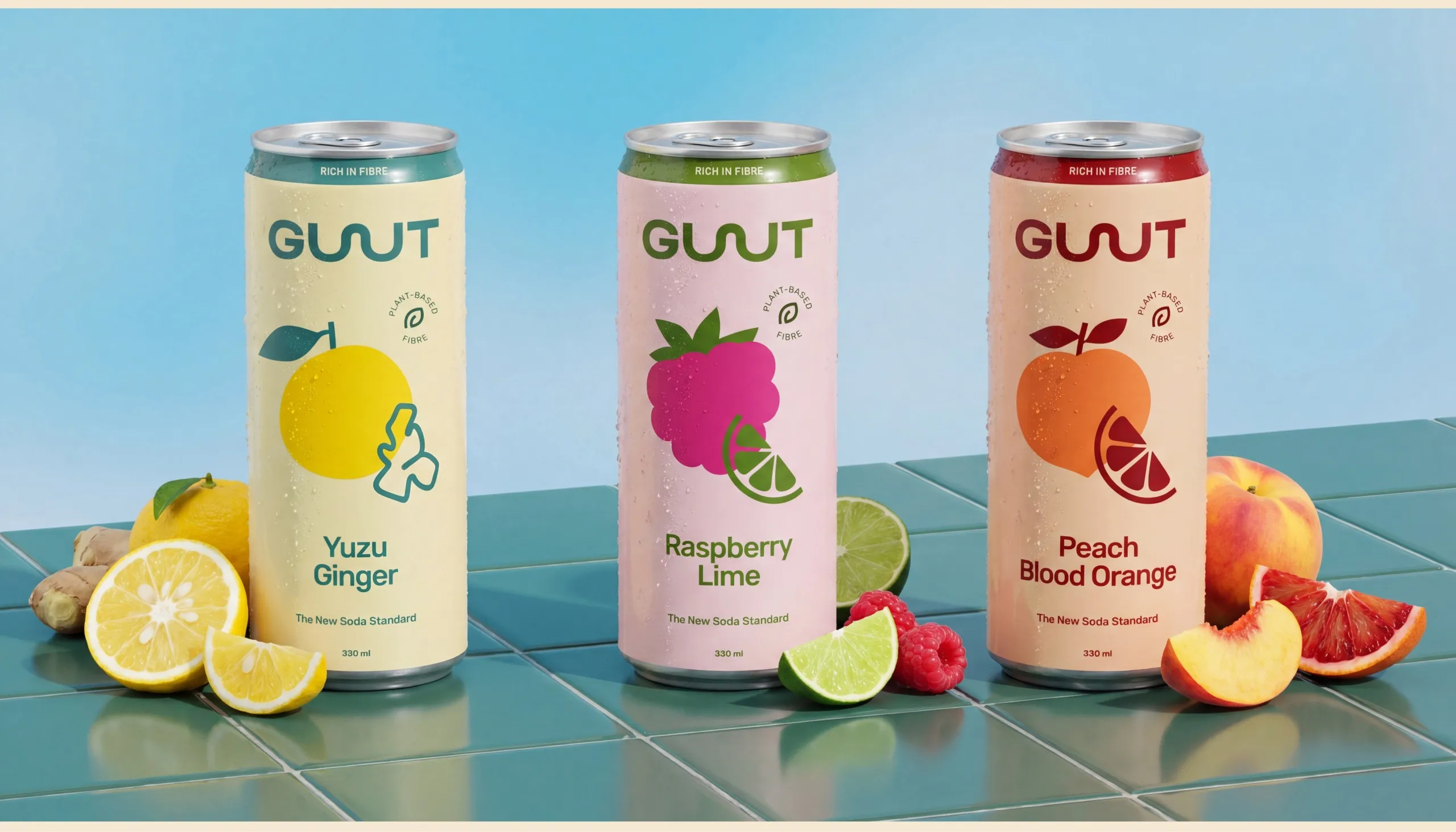
A can is one continuous surface. The artwork wraps the full circumference, 360 degrees, and only the lid and the base sit outside it. There is room for large illustration, and there is no natural front: the shopper sees one band of the curve at a time, and the can may be standing at any rotation.
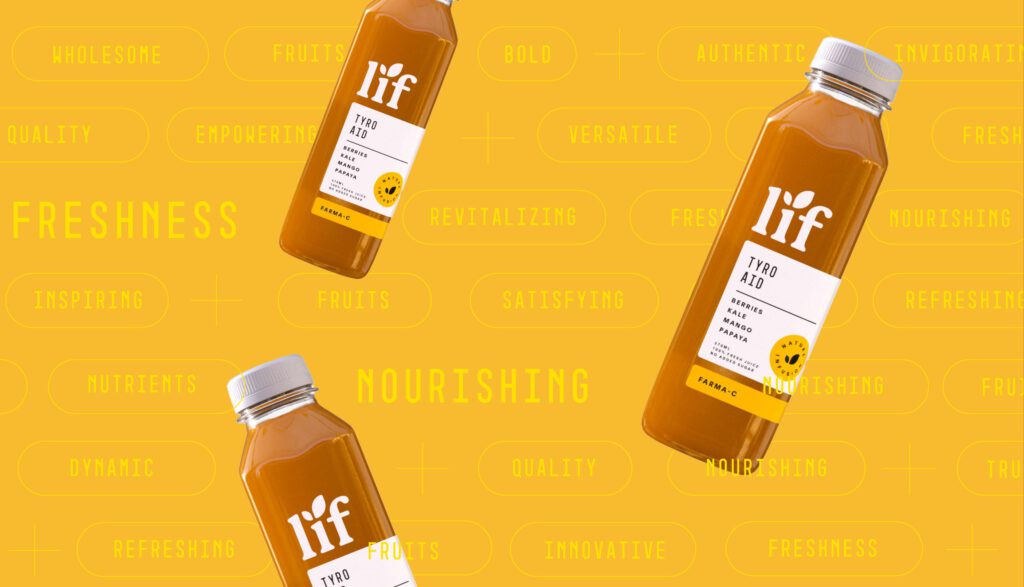
A bottle divides the surface for you. The label is a panel with edges, the glass or plastic around it is part of the picture, and the neck and the cap add small surfaces of their own. A front label and a back label separate the selling side from the information side, which a can has to achieve inside a single wrap.
A smaller panel forces an order of reading. The Lif Juices case study on our site puts it plainly: “Juice packaging design fails when the label tries to list everything at once.” The visual language in that project communicates ingredients, flavour profiles and product purpose in a fixed order.
2 practical points follow:
- On a can, plan 2 or 3 viewing bands and decide what each one shows, so that the brand name is visible from more than one side.
- On a bottle, decide what the container itself contributes. A clear bottle shows the liquid, and our guide to keeping a label readable on clear and frosted bottles explains what that background does to the type.
How each format looks on a shelf and in a cooler
Shelf and cooler are different viewing conditions, and most drinks meet both. On an ambient shelf the pack faces forward. Behind a cooler door it is seen through glass, in a row of similar shapes, sometimes at an angle.
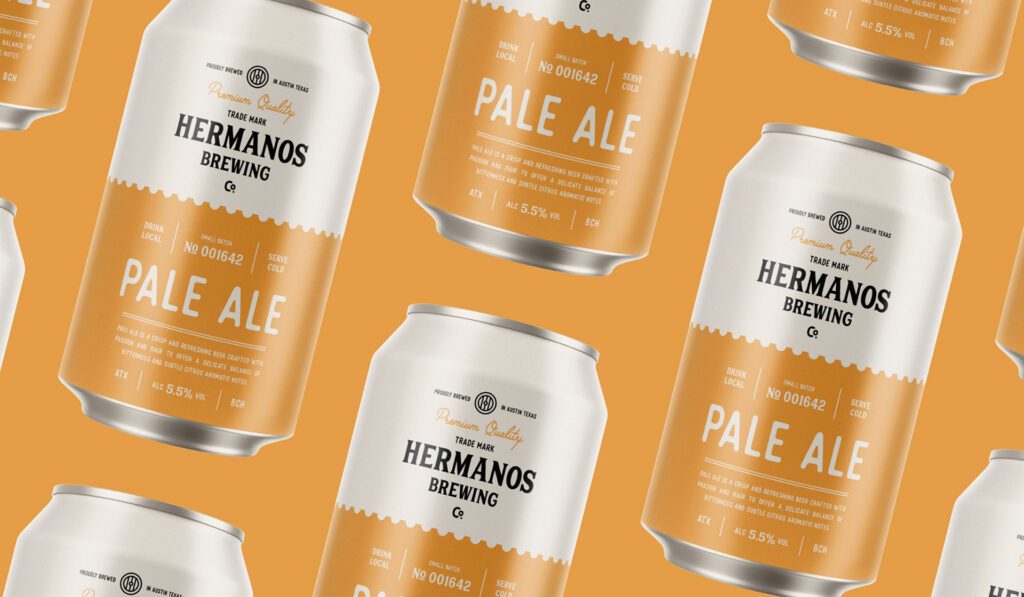
Our Hermanos Brewing Co. case study describes the cooler directly: “On a cooler shelf, where bottles sit shoulder to shoulder and labels are read at an angle, this is what separates one beer from the next before the name registers.” The answer in that project was colour. A set of soft, saturated tones gives each brewing type a colour of its own.
The same test applies to either format, with different weak points:
- Cans in a row show a narrow strip each. Put the brand and the variant colour in a band that still reads when part of the can is hidden by its neighbours.
- Bottles in a row show their labels and their caps. A cap or a neck in the variant colour helps when the label is turned away.
Cold adds water. Condensation, ice and wet hands change what survives on a label, and our guide to drinks labels in ice and condensation has a section on why a bottle, a can and a box are 3 different problems in those conditions.
A range system on cans and on bottles
Few drinks stay a single product. A second flavour usually follows, and a second format often does: a brand that starts in cans may add a bottle later, or the reverse. The format decision is therefore also a decision about how the range will grow.
We build range systems in a fixed order. The constant elements come first, which are the mark position, the type hierarchy, the information block and the shelf-facing panel. Then we define what may change for each variant. On a can the variable is usually the colour of the printed wall and an illustration. On a bottle it is the label colour, the cap, and the liquid itself where the container is clear.
Count the artworks early. With 3 flavours in 1 format there are 3 files. The same 3 flavours in a can and a bottle make 6, and each one needs its own proof. If both formats are likely, draw the 2 master layouts together, so that the logo position and the variant colours agree before either goes to print.
Each new flavour and each new size also needs a barcode number of its own. Our guide to packaging for many flavours, sizes and formats explains that rule and shows how US labelling rules measure the front of a can or a bottle. Ask GS1 or your retailer how a second format of the same drink is numbered.
Where the barcode goes on a can and on a bottle
The barcode needs a place in the layout from the first draft, and the 2 formats offer different ones. GS1 US, in its guidance on placing barcodes on products, gives the general rule: “In general, for an item scanned at checkout, you would put the barcode in the lower right-hand section of the back of the package.” It adds: “Avoid the edge of the package, and allow enough white space surrounding the barcode to help to ensure a clean scan.”
On a bottle with 2 labels, the back label is the obvious home. A can has no back until the artwork creates one. Choose one side of the wrap as the back, group the barcode there with the ingredients and the address, and keep the opposite band for the brand.
The same page says other guidelines exist for curved items and leaves the detail to the full GS1 placement guidelines, so the direction of the bars on a narrow can or a slim bottle is a question for your printer.
GS1 US names black bars on a white background as the best combination, which on a printed can calls for a white or light panel behind the code. On a clear package, the page notes, the background is the colour of the contents, so a dark drink behind the bars needs checking. Our guide to barcode colours and size gives the limits for both.
Deposit and labelling rules by market
In some markets the rules follow the container material. Here are 2 examples.
In England and Northern Ireland, GOV.UK’s guidance on the Deposit Return Scheme says customers will pay a refundable deposit on certain single-use drinks containers from 1 October 2027. The deposit applies to containers that “are made wholly or mainly from aluminium or steel, or polyethylene terephthalate (PET) plastic” and that “have a capacity of between 150 millilitres and 3 litres”. An aluminium can in that range is in scope, and so is a PET bottle. Glass is absent from that list. Scotland will have separate legislation, and the page links to separate information for Wales.
Producers in scope must register, apply the deposit and comply with scheme labelling requirements. The deposit management organisation is to provide the detail of that labelling, so reserve space for it now. Product lines of less than 5,000 units per year count as low-volume: they carry no producer fee, deposit or scheme labelling, and the producer still registers and reports.
In the United States, the packaged food rule in 21 CFR 101.5 states: “The label of a food in packaged form shall specify conspicuously the name and place of business of the manufacturer, packer, or distributor.” That block needs the same room on a can wrap as on a back label. Your regulatory adviser confirms which rules cover your drink and the wording; we design the layout. Our guide to what changes on the label in a second market covers the step after that.
What US recycling data says about cans and glass
Founders often ask which format is recycled more. Published data answers a narrower question. The US EPA reports how much of each material in municipal solid waste was recycled, and the figures on its material pages run to 2018.
For aluminium, the EPA aluminium data opens with this: “The largest source of aluminum in municipal solid waste is aluminum cans and other packaging.” The recycling rate for aluminium containers and packaging as a whole was 34.9 percent in 2018. Within that group, beer and soft drink cans were the most recycled category at 50.4 percent, or 0.67 million tons.
For glass, the EPA glass data states: “The amount of recycled glass containers was 3.1 million tons in 2018, for a recycling rate of 31.3 percent.” That figure covers all glass containers, including bottles and jars for food and cosmetics.
Read the 3 percentages with care. They describe the United States in 2018. The categories differ as well: 50.4 percent is for beer and soft drink cans alone, while 31.3 percent is for every glass container.
A recycling statement on a can or a label is a claim, and its wording depends on the market where the drink is sold. Leave a place for a material mark in the information block, and have your adviser confirm what may be printed there before the artwork is signed off.
Working with MarkaWorks on your drinks format
MarkaWorks designs drinks packaging within a wider body of food and drink work, and our packaging service page counts 17 case studies in that category. In our packaging and product design projects the structure comes first, so the choice between a can and a bottle, with its material, closure and production method, is settled before any artwork.
If you are still choosing between a can and a bottle, we can work through the 3 questions with you and draw both options far enough to compare them: the brand band on the can at 2 rotations, and the front and back labels on the bottle, each with the barcode and the address block in place.
Once the format is chosen, the range system follows. We decide what stays in the same place on every can or bottle, from the mark to the information block, and then define what changes for each flavour.
The final artwork is drawn on the dieline your filler or printer supplies for each format, and the working files come with it. The mandatory wording for each market is confirmed by your regulatory adviser, and our layout holds it.
If you are launching a drink and the format is still open, you can work with us on it. Tell us about the drink, the markets and the formats you are weighing, and we will come back with how we would approach it.
Questions drinks founders ask about cans and bottles
Is a can or a bottle better for a new drinks brand?
Neither wins in general. The choice rests on 3 things: the surface you want to design on, where the drink will be seen, and the rules in your markets. Your producer answers the questions about filling and about how the drink keeps in each container.
Will a glass bottle carry a deposit under the Deposit Return Scheme in England?
The GOV.UK guidance lists containers made wholly or mainly from aluminium, steel or PET plastic, with a capacity of 150 millilitres to 3 litres. Glass is absent from that list. The scheme starts on 1 October 2027 in England and Northern Ireland; check Scotland and Wales separately.
Where does the barcode go on a can?
GS1 US advises the lower right-hand section of the back of the package for items scanned at checkout, away from the edge and with white space around it. A can has no fixed back, so the artwork defines one and the barcode sits there.
Can the same design be used on a can and a bottle?
The identity can be shared, and each format needs a layout of its own. A can is printed all the way round, 360 degrees, and a bottle label is a panel with edges. Draw 1 master layout per format, with the same logo position rules and variant colours.
More brands we brought to life: