From 3 to 5 traits to finished lines: how to write a brand voice for the front of the pack, the back, the box, the carton, the product page and the email, and where plain language and the law set the limits.
Write a tone of voice for a product brand as a short document with 4 parts: 3 to 5 traits defined in 1 sentence each, wording rules, finished lines for the 6 places the brand speaks, and the limits on what it may say. Start from the audience, write the functional text in plain language, and test every line at print size.
What a tone of voice is on a product
A tone of voice is the written half of a brand. The identity decides how the product looks, and the voice decides how it sounds in every sentence a buyer reads, from the 4 words on the front of the pack to the email that confirms an order.
Write the voice as a short set of decisions that anyone on the team can apply without asking the person who wrote them. The document has 4 parts:
- 3 to 5 voice traits, each defined in 1 sentence.
- Wording rules: person, sentence length, the words the brand uses and the words it leaves out.
- Finished lines for each place the brand speaks.
- The limits: what the brand must never say, and which statements need evidence or a legal check.
The last part comes from positioning. Our article on how to position a product brand covers the decision about what a brand must never say, and this article starts where that one stops: the position is written, and the open question is how it sounds.
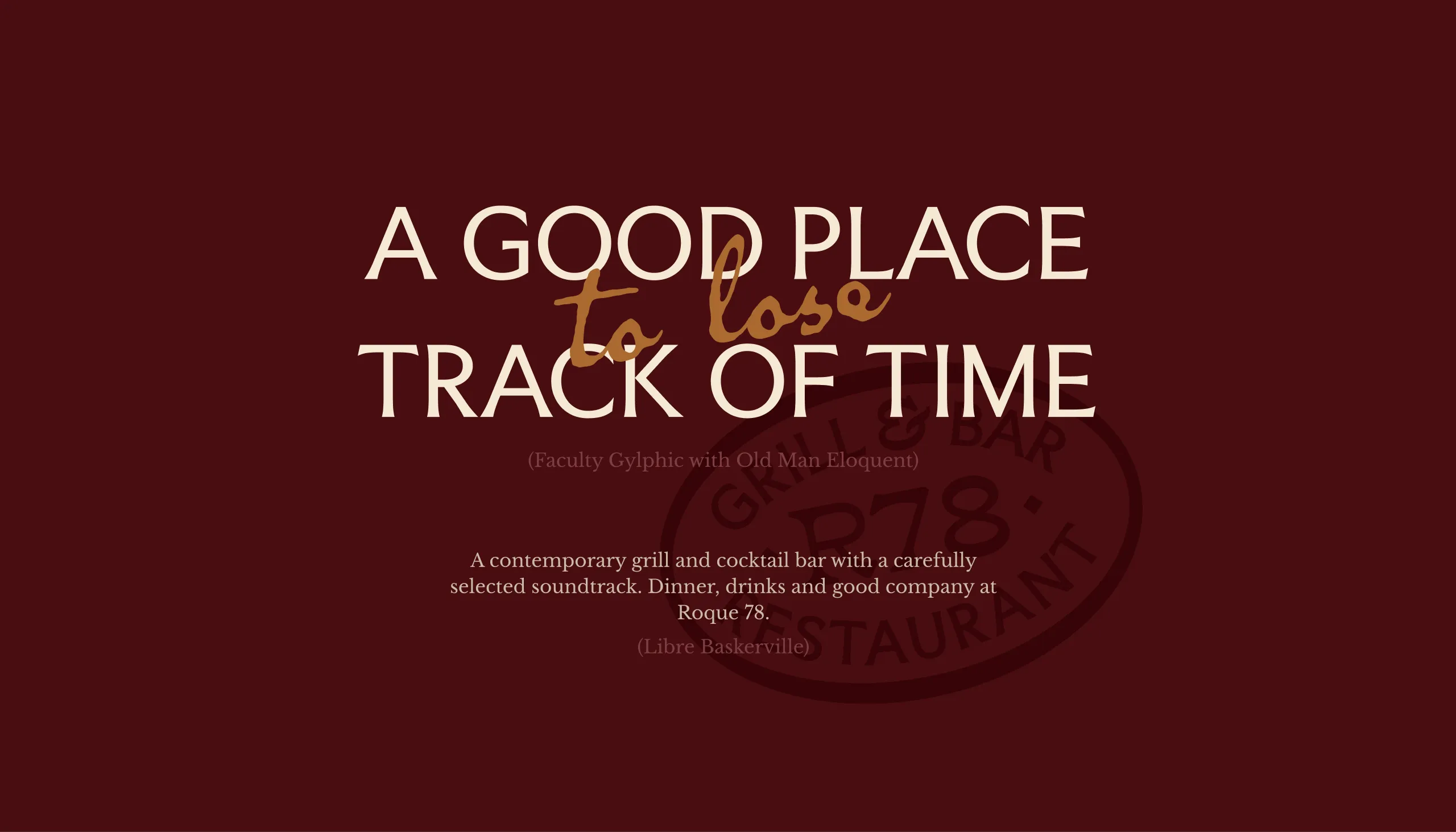
In our Roque 78 case study, the challenge reads like a voice brief: “Roque 78 needed to feel sophisticated without becoming formal, and nostalgic without turning into a themed retro restaurant.” The identity includes handwritten phrases, and the case study names 2 of them: Let your evening groove and 78 RPM.
The audience comes first
Every voice decision depends on who is reading. The plain language guide published by digital.gov for United States federal websites opens its advice with that point: “The first rule of plain language is: write for your audience”.
The guide also corrects a common misreading, which is that plain writing means writing down to everyone. Its instruction is: “Use language your audience understands and feels comfortable with.” A barista ordering wholesale coffee and a parent choosing a snack in a supermarket use different vocabularies, and a voice written for 1 of them will sound wrong to the other.
Before any trait, write down 3 things about the reader:
- What they already know about the category, and the words they use for it.
- Where they meet the product first: a shelf, a search result or a recommendation.
- What they are doing at that moment, and how long they have.
If those answers are still open, our brand strategy and visual identity work settles them first, because a voice written before the audience is fixed has to be rewritten when the audience changes.
One reader is easy to forget: the person who will write the next label. A voice document has 2 audiences, the buyer and the team, and it should be short enough for a new colleague to read in full on day 1.
From adjectives to rules a writer can follow
Most voice work starts with adjectives, and much of it stalls there. Friendly or premium could describe half the brands on a shelf. An adjective becomes useful when it is turned into a rule.
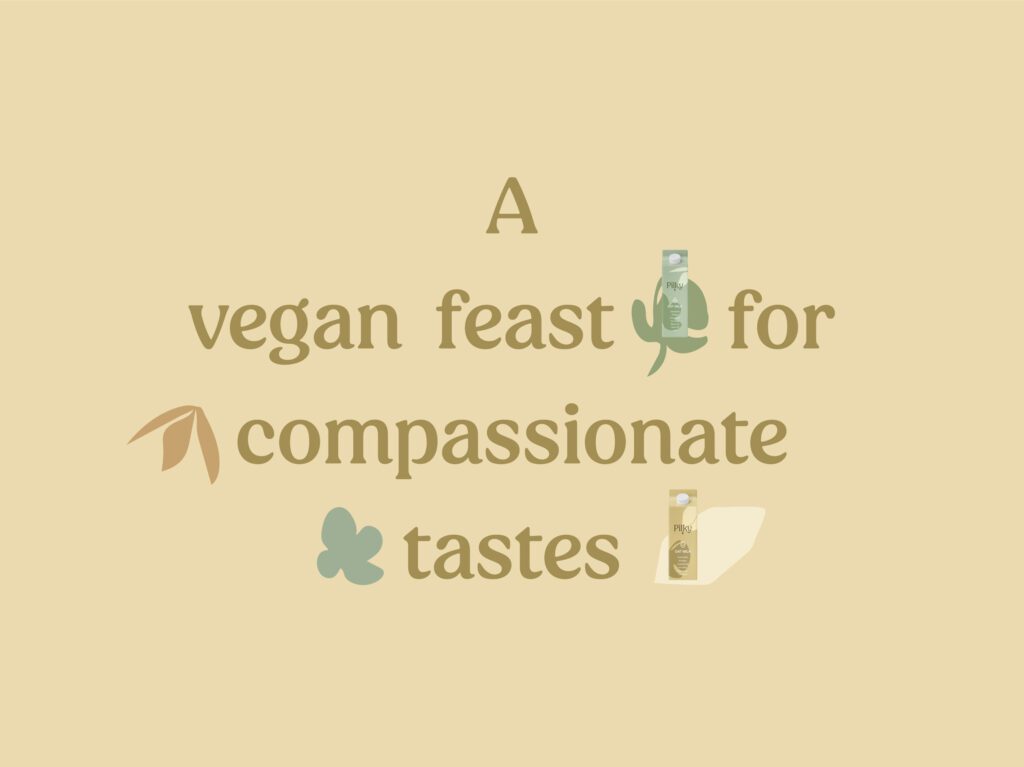
Our Pilky case study names 4 core adjectives for the brand: simple, modern, luxurious and natural. The same page describes the packaging in a sentence that could sit in a voice sheet: “Clean layouts and carefully structured information hierarchy ensure ease of reading and instant recognition.”
For each trait, write 3 lines:
- What it means for this brand, in 1 sentence.
- What it does to the wording: sentence length, person, punctuation.
- A pair of example lines, 1 that fits and 1 that fails.
Take the trait simple. The rule might read: 1 idea per sentence, no more than 12 words on a front panel, and each variant named with the plain word a shopper would use. Those numbers are a working example, and every brand sets its own.
Take the failing lines from the brand’s own early drafts, because a writer who has seen 1 line fail can recognise the next.
When the traits are fixed, they go into the brand guidelines beside the logo and colour rules. Our guide to what belongs in a brand guidelines document lists the other sections. If the product starts as a white label item, see turning a white label product into a real brand.
The 6 places the voice lives
A product brand speaks in more places than its owner usually counts. Map 6 of them before writing, because the reader is in a different situation at each one.
- Front of pack. The buyer is choosing. The front carries the brand name, the product name, the variant and at most 1 short line.
- Back of pack. The buyer is checking. The voice shows mainly in how clearly the instructions are written.
- Inside the box. The buyer has already bought. A printed flap, a card or a leaflet is read once, at opening, and can hold a longer and warmer sentence than the outside.
- Shipping carton. The reader may be a courier or a warehouse team as well as the customer. Handling text comes first, and 1 brand line is enough.
- Product page. The buyer cannot pick the pack up, so the page has to say what the hand would learn: size, format and what is inside.
- Email. Order confirmations, delivery notices and replies to questions are written by the team every day. A voice tends to drift here first.
Write 1 or 2 finished lines for each place and put them in the voice document. A rule such as short and direct produces 8 words on a front panel and 80 words in an email, and finished lines show that difference better than a description does.
| Place | What the reader is doing | What we write there |
|---|---|---|
| Front of pack | Choosing | Brand name, product name, variant and at most 1 short line |
| Back of pack | Checking | Instructions in plain language beside the ingredients and mandatory information |
| Inside the box | Opening the product after buying it | A longer, warmer sentence on a flap, a card or a leaflet |
| Shipping carton | Handling or receiving the parcel | Handling text first, then 1 brand line |
| Product page | Deciding without the pack in hand | Title, bullet points and description that state size, format and what is inside |
| Following an order or asking a question | Order confirmations, delivery notices and replies written to the same rules |
Plain language on the panels that inform
Most of the words on a pack are there to inform: how to use the product, what is in it, how to store it. On these panels, write in plain language, whatever the brand’s traits are.

The digital.gov guide lists practices that suit a back panel. One reads: “Use the active voice. Active voice helps the message stay clear and easy-to-read.” Another reads: “Use lists. They can help you convey detailed information quickly without overloading your readers.” A line such as Add 2 scoops to 250 ml of water tells the reader who does what, and 3 numbered steps are easier to follow than 1 long paragraph.
Our Friday Floats case study makes a related point about design. The emblem is playful, so the logotype was kept classic, and the case study gives the reason: “a mark this playful needs something steady underneath it”. In copy, when the front line is expressive, the instructions stay plain, and the brand reads as joyful on the front and dependable on the back.
For food sold in the EU, legibility is also law, and our article on how small type can be on packaging covers type size in detail. Article 13 of Regulation (EU) No 1169/2011 requires the mandatory particulars in type with an x-height of at least 1.2 mm, or 0.9 mm where the largest surface of the pack is smaller than 80 cm2.
Where the law limits the voice
What a brand may say is set partly by law, and the limits depend on the category and the market.
In the EU, Article 7 of Regulation (EU) No 1169/2011 covers food. It states: “Food information shall be accurate, clear and easy to understand for the consumer.” Food information may not mislead, for example “by attributing to the food effects or properties which it does not possess”. Paragraph 4 extends the article to advertising and to the presentation of foods, including their packaging. A playful line on the front of a food pack is therefore read under the same article as the ingredient list.
In the United States, 16 CFR 260.12, part of the Federal Trade Commission’s guides on environmental marketing, begins: “It is deceptive to misrepresent, directly or by implication, that a product or package is recyclable.” An unqualified statement fits when recycling facilities are available to at least 60 percent of the consumers or communities where the item is sold. Even 2 friendly words count: 1 example in the section concerns a can labelled Please Recycle, which likely conveys that the can is recyclable. We cover environmental statements in green claims by market.
Put these limits into the voice document as a list of statement types that go to review before printing. Your regulatory adviser confirms the wording; we design the layout and write inside what has been confirmed. Other categories and markets have their own rules, so check with your adviser before reusing a line.
Testing the voice before it is printed
A voice document stays a draft until someone has used it. Test it in 4 ways before anything goes to print.
- Read it aloud. Every line for the pack is read out by someone who did not write it.
- Cover the logo. Set 3 of your lines beside 3 lines from elsewhere in the category, all without names, and ask a colleague to pick yours. If they cannot, the traits are too general.
- Give it to a second writer. Someone outside the project writes a new product description using only the document. What they get wrong shows which rule is missing.
- Set it at real size. The line is placed in the artwork at print size. A sentence that reads well in a document can break badly across 3 lines on a label 40 mm wide.
The digital.gov guide lists testing content, to make sure it communicates what the writer intended, beside defining the audience and writing the text.
Translation is the last test. A line built on wordplay may not survive a second language. The name has the same problem, which we cover in our article on choosing a product brand name for more than one country. For the voice, mark each line in the document as translate, adapt or keep in the original language, so a distributor in a second market knows which lines may be rewritten.
After launch, add each new line that worked to the document and date every revision.
Working with MarkaWorks on your brand voice
We write tone of voice as part of our brand work at MarkaWorks, alongside the identity and the packaging the words will be printed on. The practical benefit is that the person writing the front line can see the panel it has to fit.
Our range systems fix the constant elements first, among them the type hierarchy and the information block, and then define what changes for each variant. Copy follows the same logic. The structure of a front panel stays fixed, so a new variant needs new words in the same positions and no new layout.
Food and drink is a category we work in regularly. The food and drink category on our site holds 17 case studies, and coffee and tea holds 20.
The voice decisions and the finished lines for each surface are handed over with the working files. Where a statement has legal weight, the wording goes to your regulatory adviser first and we set the layout around the approved text.
If you are launching a product brand or rewriting the words on an existing one, you can work with us on its voice. Tell us about your product and where it will be sold, and we will explain where we would start.
Questions brand owners ask about tone of voice
How many voice traits should a product brand have?
Write 3 to 5. Each trait gets 1 sentence that defines it for the brand, a note on what it does to the wording, and a pair of example lines, 1 that fits and 1 that fails. Fewer than 3 gives a writer too little to work with.
Is a tone of voice the same as a tagline?
No. A tagline is 1 line. A tone of voice is the set of rules behind every line the brand writes, including instructions, product descriptions and order emails. Write finished lines for 6 places: the front and back of the pack, the inside of the box, the shipping carton, the product page and email.
Does the brand voice apply to mandatory label text?
Only around it. The wording of mandatory information follows the rules of the market, and your regulatory adviser confirms it. For food in the EU, Article 13 of Regulation (EU) No 1169/2011 also sets a minimum x-height of 1.2 mm. The voice shows in the instructions and the optional text.
Can a playful brand voice talk about recycling?
Yes, inside the rules of the market. In the United States, 16 CFR 260.12 allows an unqualified recyclable statement when recycling facilities are available to at least 60 percent of consumers or communities where the item is sold. Below that level the wording has to be qualified.
More brands we brought to life: