The 4 tests a name has to pass in each market, how it behaves on the pack and in another alphabet, and where the trademark attorney comes in.
Choose a product brand name by testing a shortlist against 4 questions in every market: can people say it, does it mean something bad in the local language, can it be registered as a trademark, and are the domain and social handles free. Run the checks with native speakers and a trademark attorney before any logo is drawn.
A name has to pass 4 tests in every market
A name that works at home has been checked by one group of people, in one language, against one trademark register. Add a second country and each of those checks has to be run again. A name is also hard to change later: a new one means new filings, new artwork and a new web address.
So put every candidate name through 4 tests for each market on the launch list:
- Can people there say it and spell it?
- Does it carry a bad or comic meaning in their language?
- Can it be registered as a trademark?
- Are the domain and the social handles available?
A name has to pass all 4 in every market. One that is easy to say in 3 countries and blocked by an earlier trademark in the 4th has failed, however much the team likes it.
2 more questions sit beside the tests, and they are design questions. How does the name look on the pack at the size it will be printed? And what happens to it in a market that reads a different alphabet? If the brand will be sold in several countries from the start, our guide to keeping branding consistent across countries covers the parts of the identity that sit around the name.
Can people say it and spell it?
Start with speech, because a product name is passed on by voice. Write each shortlisted name on a card, show it to a native speaker of each target language, and ask them to read it aloud without help. Then do the reverse: say the name and ask them to write it down.
You are listening for 3 things:
- Hesitation. If the reader pauses or asks how it is said, customers will too.
- Different versions. If 5 readers produce 3 pronunciations, the name will split in use.
- Spelling drift. If people who hear the name cannot type it, they will struggle to find the website.
Letter combinations are read differently from one language to the next, and we cannot predict every case from a desk. That is why the test uses real speakers. Ask at least 2 people per language, and choose people outside the project, because the team has already heard the name said the intended way.
Length alone does not decide the result. A short name can fail this test and a longer one can pass it. Record each session, with permission, so the whole team hears the same answer.
What does the name mean in the other language?
A name can be easy to say and still be the wrong word. The second test looks for meanings the team cannot see because nobody on it speaks the language.
Give the native speaker the name without the brief and ask 4 questions:
- Does this word, or a word that sounds like it, mean anything to you?
- Does it remind you of slang, an insult or a joke?
- Does it sound like a brand or a product you already know?
- What kind of product would you expect it to be?
The last question matters as much as the first. A name with no bad meaning can still suggest the wrong category, such as a cleaning product when you are selling a drink. That is a positioning problem, and our article on how to position a product brand explains why the name has to agree with the place you want in the customer’s mind.
Check regional use too. A word can be neutral in one country and rude in another that shares the language, so ask a speaker from each country on the list, not 1 speaker per language. Dictionaries and translation tools are a first filter only, because they miss slang and recent usage.
A name that makes 2 of 6 people smile for the wrong reason goes back to the list.
Can the name be registered as a trademark?
The third test is legal, and it is decided by a trademark attorney and the trademark offices, market by market.
For filing in several countries at once there is the Madrid System, run by WIPO. WIPO describes it this way: “File a single international trademark application and pay one set of fees to apply for protection in the 133 countries covered.” Those 133 countries are covered by the system’s 117 members.
3 points on the same page shape the naming work:
- One application does not mean one decision. WIPO states: “The intellectual property (IP) office of each member where you seek protection will decide whether it can grant protection under its own domestic laws.” A name can pass in one market and fail in the next.
- You need a base. To use the system you must already have, or have applied for, a national or regional trademark registration with the office of a Madrid System member.
- Search comes first. WIPO’s instruction is: “Search for identical or similar trademarks in your target markets before you file an international trademark application.”
Territory is precise too: “Protection in China does not include Hong Kong or Macao.”
Your attorney reads what those searches return and tells you which names are worth filing, and in which office.
Are the domain and the social handles free?
The fourth test is the quickest to run and the easiest to misread. A free domain proves nothing about the trademark, and a registered trademark does not hand you the domain. Run it alongside the attorney’s first search.
Check 4 things for each name:
- The exact name on the main global domain ending and on the country endings for each launch market.
- The same handle on every social platform your customers use. One handle everywhere is easier to print on a pack than 3 variations.
- Who holds the near misses: the name with a hyphen, with a common misspelling, or with the product word added.
- What is on those pages now. A dormant page is a different risk from an active business in your category.
If the exact domain is taken, adding a product word to the address is a workable fix as long as the brand name itself is unchanged. Changing the spelling of the name to match a free domain is a different decision, because it sends the name back through tests 1, 2 and 3.
Keep a dated record of what was free on which day. Register what you need once the attorney’s first search is back. The table below sets out all 4 tests, how each one is run and who runs it.
| Test | How it is checked | Who does it |
|---|---|---|
| Pronunciation and spelling | Native speakers read the name aloud from a card, then write it down after hearing it | The brand owner and the agency, with at least 2 speakers per language |
| Meaning in the local language | Native speakers from each country are asked about meanings, slang, similar brands and the product they expect | The brand owner and the agency, with speakers from each country |
| Trademark registration | Search for identical or similar trademarks in the target markets, then file nationally, regionally or through the Madrid System | A trademark attorney; the office of each market decides |
| Domain and social handles | Exact name on global and country domain endings, the same handle on each platform, and who holds the near misses | The brand owner or the agency, alongside the attorney’s first search |
| Legibility on the pack | The name is set at the smallest printed width, printed and read | The agency |
| Other alphabets | Decide between Latin letters, a version written by sound and a translation; repeat the speaker check for each version | The agency and native speakers; the attorney advises on filing |
How does the name sit on the pack?
A name is read on a pack as well as heard, so look at each shortlisted name as a piece of type before anyone commits to it.
Length. Count the characters. A 4-letter name can run large across a narrow label. A 12-letter name on the same label has to be set smaller, stacked on 2 lines or turned on its side.
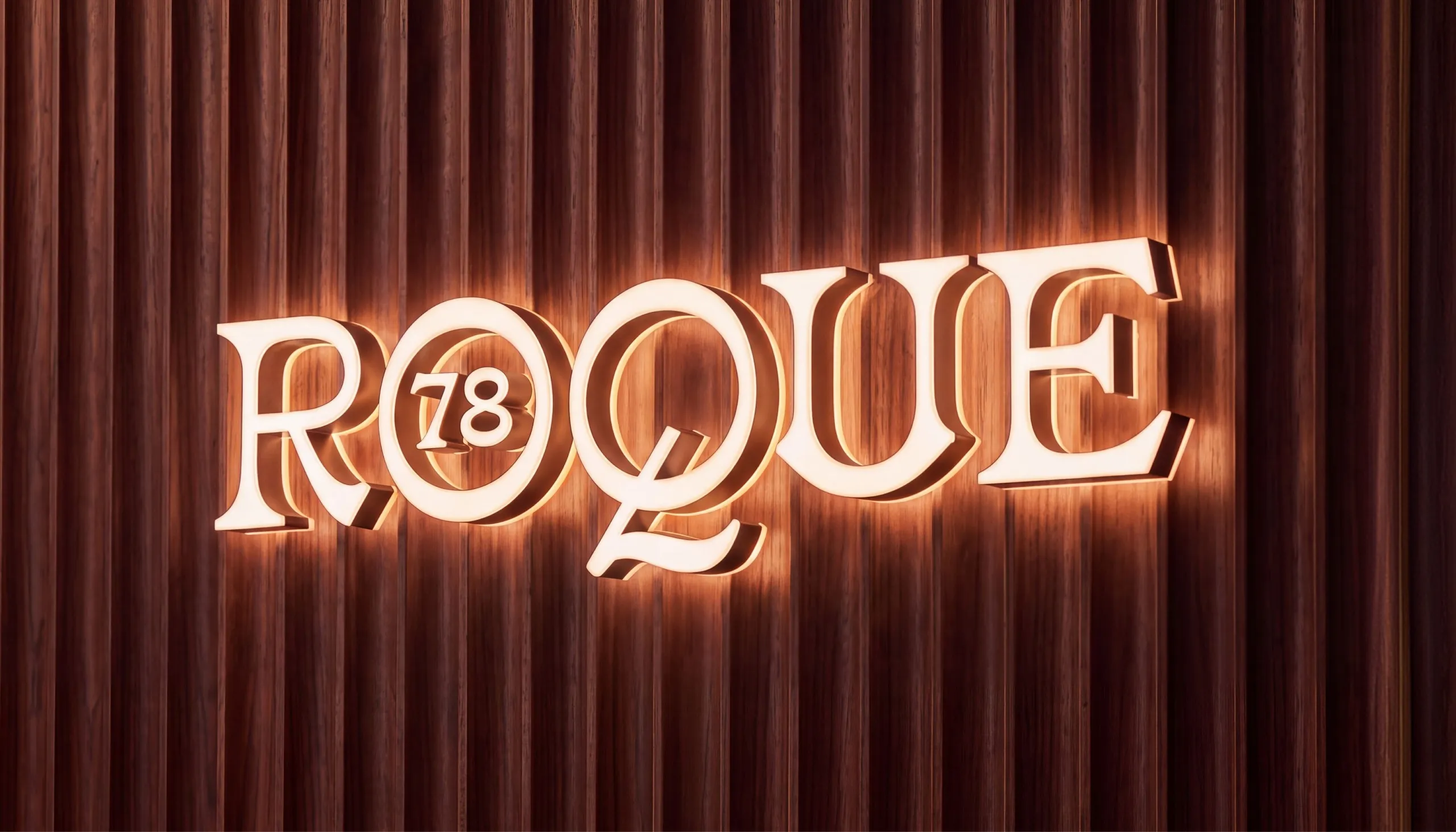
Letterforms. One letter can carry the whole mark. Our Roque 78 case study records this: “The Roque wordmark was developed around distinctive custom letterforms, with the extended Q giving the logo its most recognisable gesture.” Look also for pairs that blur at small sizes, such as a lowercase l beside a capital I.
Small sizes. Set the name at the smallest width it will appear, for example 10 mm on a cap, and print it. Our guide to how small type can be on packaging gives the working limits.
Other alphabets. If a market reads Arabic, Cyrillic, Chinese or another script, decide early whether the name stays in Latin letters, is written by sound in the local script, or is translated. Each version needs its own native-speaker check and its own lettering, and your attorney will advise whether it needs its own filing. Mandatory text follows local rules too, which our article on label changes for a second market covers.
From a long list to a name you can file
The 4 tests work best as a funnel, with the cheapest checks first and the attorney’s time spent on the fewest names. It has 6 steps:
- Long list. Write 50 to 100 names from the positioning: real words, invented words, compounds and words from other languages.
- First cut. Remove names the team cannot say the same way and names close to a brand already in your category. Aim for 15 to 20.
- Quick screen. Search each name on the web and in the public trademark databases. WIPO lists its Global Brand Database among its trademark search tools. A clear result here is a screen and not a legal opinion. Aim for 8 to 10.
- Native-speaker check. Run tests 1 and 2 with speakers from each market. Aim for 3 to 5.
- Attorney search. Send the survivors to a trademark attorney with the list of markets and the goods you will sell. The attorney decides what is safe to file and where.
- Design test. Set the cleared names in type, on a pack and on a phone screen.
Markets added later go through the same steps. WIPO lists this among the reasons to use the Madrid System: “Complete flexibility to add new countries whenever your business is ready to expand.” The name still has to pass tests 1, 2 and 4 in each new country. Name your likely second and third markets now, even if you launch in 1. The name is also only 1 part of what can be protected. In the United States the Supreme Court held in Qualitex v. Jacobson “that there is no rule absolutely barring the use of color alone” as a trademark. Our article on whether you can trademark a colour looks at 2 other cases.
Where naming fits in our brand strategy work
Naming belongs at the start of our brand strategy and visual identity work, after the positioning is agreed and before the mark is drawn. The order matters because a wordmark is drawn from the letters of the name. If the name changes after the attorney’s search, the drawing starts again.
MarkaWorks develops the names, takes the shortlist through the pronunciation, meaning and availability checks with you, and designs the visual identity for the name that clears. Your trademark attorney runs the legal search and confirms what can be filed in each market; we design the name and the identity around that answer.
From there the name moves onto the product. Our packaging and product design work starts with the structure, meaning the format, material, closure and production method. The range system then gives the mark a fixed position on every pack. You can see marks from this year on the pack, the sign and the screen in our Logos and Marks 2026 selection.
If you are naming a product for 2 or more countries, we would be glad to work on it with you. Tell us which markets you are planning for and what you will sell there, and we will reply with the steps we would take for the name and the identity.
Questions brand owners ask about naming for several countries
Do I need a separate trademark filing in every country?
Not always. WIPO’s Madrid System lets you file a single international trademark application for the 133 countries it covers. The office of each member still decides whether it can grant protection under its own domestic laws, so ask your trademark attorney which route suits your markets.
Can the Madrid System be my first trademark filing?
No. WIPO says you must already have, or have applied for, a national or regional trademark registration in the IP Office of a Madrid System member. You also need to be a national of, or have a domicile or business in, one of the 133 countries the system covers.
Should the product have the same name in every country?
One name is simpler to print, register and search for, so start from that aim. If the name fails the pronunciation or meaning test in 1 market, compare 2 options with your attorney: a different name there, or a new name everywhere.
When should a trademark attorney see the names?
Before the logo is drawn. Send a shortlist of 3 to 5 names with the list of markets and the goods you will sell. The wordmark is drawn from the letters of the name, so a name that is refused after design means the drawing starts again.
More brands we brought to life: