What takes over when a foil, a laminate or a window leaves the pack, what EU, UK and US sources say about recyclability, and where the recyclable claim sits on the label.
Give every finish the pack loses a replacement: a stricter type hierarchy, 2 or 3 colours in fixed proportions, a structure that fits the product closely, and a print proof on the new material. Then word the recyclable claim narrowly. The US FTC guides allow an unqualified claim only where at least 60 percent of consumers or communities have access to recycling facilities.
What changes when a pack moves to one recyclable material
A move to recyclable packaging usually starts with a list from the converter. One material replaces a combination of several, and some of the things that made the old pack feel finished may be on that list: a laminate, a metallic foil, a plastic window, a closure made from a second material. Your converter and the recyclability assessment decide which of them has to go, and design decides what happens next.
A pack looks cheaper only when a lost effect was doing a job and nothing takes the job over. So before any artwork changes, ask 3 questions about each effect that is leaving:
- What did it signal: quality, a variant, a focal point, protection?
- Which design decision can carry that signal now: type, colour, structure or print quality?
- Does the brand still need the signal at all?
The third question removes more than most brand owners expect. Our article on what makes cosmetics packaging look expensive argues that a premium pack commits to a small number of decisions and carries each one out precisely. A material change forces that choice at the start of the project, while the dieline can still change. For drinks, see choosing a can or a bottle.
The EU regulation and its 2030 dates
In the EU, the text to read first is Regulation (EU) 2025/40, the Packaging and Packaging Waste Regulation. The European Commission’s packaging waste page lists it as in force since 11 February 2025, with an application date of 12 August 2026. A news item on the European Circular Economy Stakeholder Platform, dated 06 Apr 2026, says the regulation “entered into force on 11 February 2025 and will generally apply from 12 August 2026”.
On recyclability, the Commission page lists this among the aims of the Regulation: “Make all packaging on the EU market recyclable in an economically viable way by 2030”. The Platform item gives 3 further dates. It says: “The regulation establishes a system of recyclability performance grades, applicable from 2030, and introduces stricter obligations on recyclability from 2038.” It also says the requirement for packaging to be recycled at scale enters into force in 2035.
These lines are quoted as the 2 sources give them. Which grade applies to your format, and from when, is a question for your regulatory adviser.
For design, the dates set the planning horizon. A pack drawn this year may still be on the shelf in 2030, so plan the recyclable version as the main design and let any transitional pack follow it.
The UK method: red, amber or green
The United Kingdom publishes its method. Under extended producer responsibility for packaging, the GOV.UK recyclability assessment methodology, known as the RAM, has applied since 1 January 2025 to large producers who supply household packaging.
The RAM sorts materials into 8 categories, and it lists paper and board separately from fibre-based composite materials. The guidance says: “Each unit of packaging or component should be assessed under one of these categories.” The outcome is 1 of 3 ratings: red, amber or green. The guidance defines the 2 ends of the scale: “green packaging is widely recyclable in the current UK infrastructure”, while “red packaging has specifications that make it difficult to recycle at scale”. The rating affects the disposal fee charged for that packaging.
Some design choices are rated red automatically. The list includes integrated electrical components, with boxes that include LED lights given as the example.
Ask the supplier how each part of your pack is rated before the artwork starts. The page describes version 1.1, published in April 2025, and says the method is reviewed every year. Older UK law points the same way: Schedule 1 of the Packaging (Essential Requirements) Regulations 2015 says packaging must be designed, produced and commercialised “in such a way as to permit its reuse or recovery, including recycling”.
| Market | Source | What it says | Date or number |
|---|---|---|---|
| EU | European Commission, packaging waste page | Aim of Regulation (EU) 2025/40: all packaging on the EU market recyclable in an economically viable way by 2030 | In force since 11 February 2025; application date 12 August 2026 |
| EU | European Circular Economy Stakeholder Platform | Recyclability performance grades are applicable from 2030; the requirement to be recycled at scale enters into force in 2035; stricter obligations follow from 2038 | News item dated 06 Apr 2026 |
| UK | GOV.UK, recyclability assessment methodology | Large producers assess household packaging and report a red, amber or green rating | From 1 January 2025; 8 material categories; version 1.1, April 2025 |
| UK | Packaging (Essential Requirements) Regulations 2015, Schedule 1 | Packaging must be designed, produced and commercialised to permit its reuse or recovery, including recycling | 2015 No. 1640, original version as made |
| US | FTC Guides for the Use of Environmental Marketing Claims, 16 CFR 260.12 | Unqualified recyclable claim allowed when facilities are available to a substantial majority of consumers or communities | Substantial majority means at least 60 percent |
Type hierarchy in place of decoration
When a foil or a spot varnish leaves, the front loses its built-in focal point, and type has to supply it. That calls for a clearer ranking than most packs have: 1 element that is plainly the largest, a second level for the variant, and a third level for everything else. Contrast in size and weight now does the work that shine used to do.

Two habits make the ranking hold across a range:
- Limit the pack to 1 or 2 typeface families and about 3 sizes.
- Set the margins and the gaps between lines as multiples of 1 unit, and repeat them on every pack.
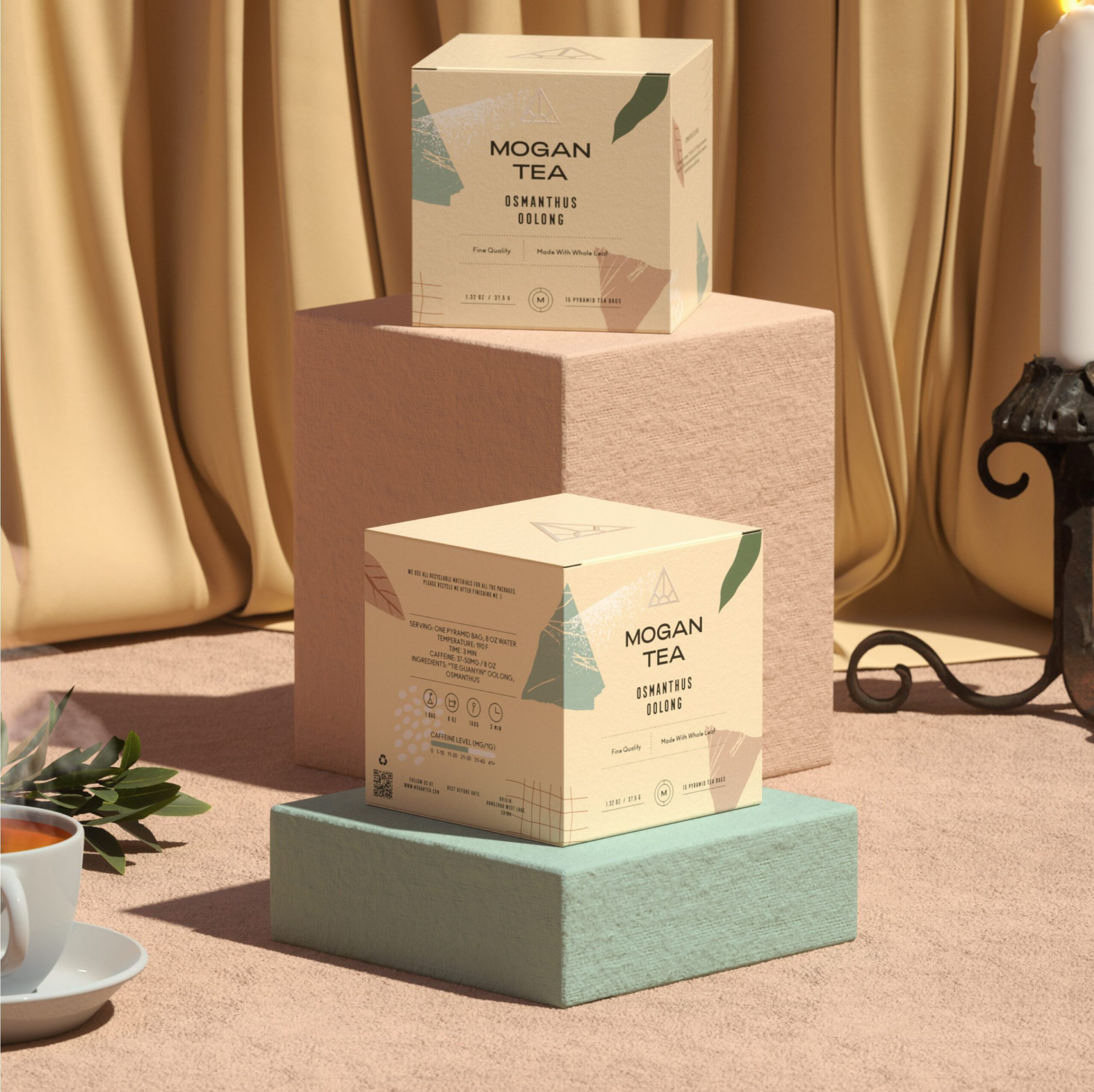
Our own work leans on this. The Mogan Tea case study puts tea type, flavour profile and brewing guidance in a fixed order, and says of the packaging: “structure is doing the work that decoration would otherwise be asked to do”. The La Mama identity takes the same route with clear hierarchy, generous spacing and structured grids. Its case study says: “Nothing competes for attention; every element has a reason to be where it is.”
Small type needs a check on the new surface. Ask the printer to include the smallest line of the information block in the proof, and read it at arm’s length before the run is approved.
Colour discipline on a plainer surface
Colour is the second replacement. A pack that has lost a metallic or gloss effect can still be recognised from across the aisle when the palette is narrow and used the same way every time. Work with 2 or 3 colours in fixed proportions: 1 that owns most of the surface, 1 for type, and at most 1 accent.
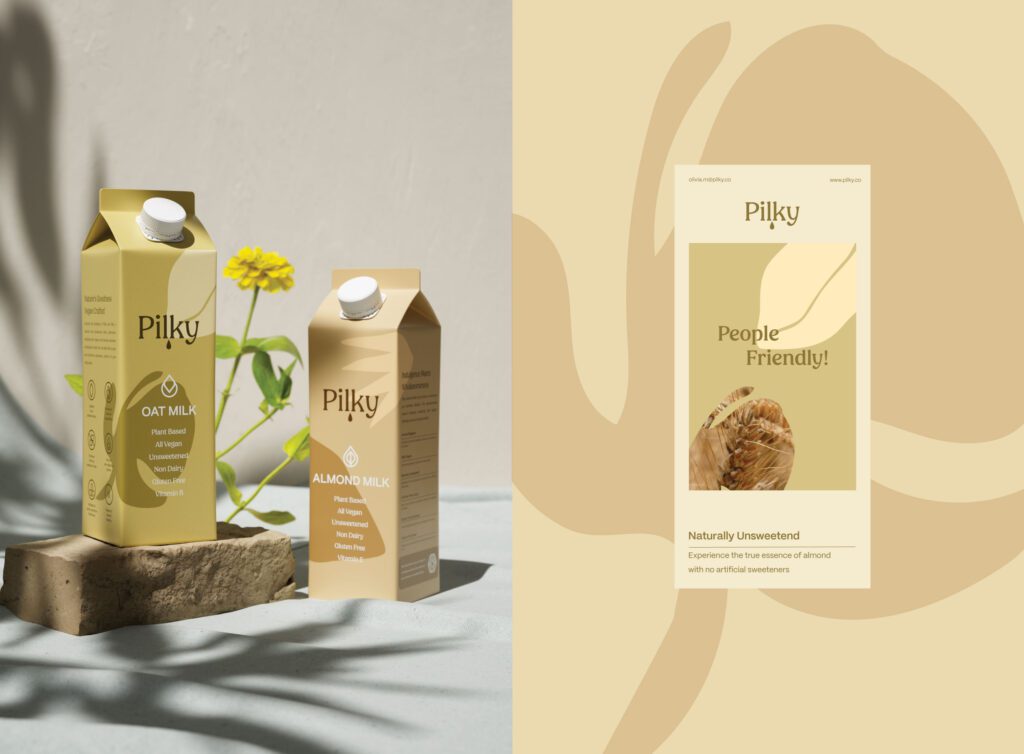
Variants are where the discipline pays. If each flavour had its own foil or its own illustration, move that job to a single colour change inside a fixed layout. The Pilky case study describes the rule for a range of almond, oat and soy products: “Each milk variant is differentiated through color while maintaining a cohesive visual system.”
A new material is a new print surface, so approve colour from a printed proof on that material. Our guide to why brand colour shifts in print covers the tolerance to agree with the printer and the lines to put in the print specification.
One study asked buyers about colour directly. A 2022 paper in Frontiers in Sustainable Food Systems showed 2 food products from organic lines in 3 packaging versions each to participants in Croatia, using webcam eye tracking and a survey. 168 people were involved, 87 completed the experiment and 33 recordings were usable. In the survey, the colour of the packaging and the visual appearance of the product were among the main reasons given for buying.
Structure and print quality
Structure is the replacement that asks least of decoration and most of planning. A carton that fits the product closely, a closure that sits flush and a fold that lands exactly on the artwork line read as quality on any material.
A single-material brief often changes the structure as well as the surface. A window may close, or a label may become direct print. Each change moves a panel edge or a glue flap, so we redraw the artwork on the new dieline from the production partner and leave the old file behind. If the new format comes from a supplier’s catalogue, our comparison of custom and stock packaging covers where each option fits. A switch that adds a refill has a second pack to design, which we cover in refill pack design for beauty brands.
Print quality is the last replacement, and buyers notice it first when it fails. With fewer effects on the pack, edge sharpness and colour consistency are fully exposed. Agree 2 checks with the printer before the run: a proof on the real material and a folded sample of the finished structure.
The GOV.UK guidance has practical advice for the same moment: “If you do not know what the packaging you supply is made of or are missing other technical details that you need to complete the assessment, contact the packaging manufacturer.” Ask for those details in writing, together with the dieline.
The recyclable claim on the label
Print the word recyclable only where it is true for the market the pack is sold in. Our guide to green claims by market covers the rules for the EU, the UK and the US, so this section stays with the layout.
The FTC’s Guides for the Use of Environmental Marketing Claims cover the word at 16 CFR 260.12. They allow an unqualified claim when recycling facilities are available to at least 60 percent of consumers or communities where the item is sold. They also say: “If any component significantly limits the ability to recycle the item, any recyclable claim would be deceptive.” Where only some parts qualify, “marketers should clearly and prominently qualify the recyclable claim to avoid deception about which portions are recyclable”. One example describes a pack of 4 bonded layers in which 25 percent of the material is recyclable, and the qualified claim states that figure.
The layout follows from those lines:
- Say which part the claim covers: the carton, the bottle or the cap.
- Keep the claim in the information block, beside the disposal instructions.
- Leave room for a qualifying line, because the wording may change by market.
In the Frontiers study above, participants looked longest at the large BIO label, while the small EU organic logo in the upper right was barely noticed or missed. In the survey, 48.9% had called such a label somewhat important. The study tested organic marks on 2 food products, so test your own placement with real buyers.
Working with MarkaWorks on a recyclable pack
A material switch is a packaging project with a fixed constraint, and we run it in the order our packaging and product design work always follows. Structure comes first: format, material, closure and production method are settled with your production partner before the artwork starts.
Then comes the range. MarkaWorks range systems set the repeating elements of the pack before the variants, so a new material changes the surface and the layout stays recognisable. Tea, coffee, food and drink are categories we work in regularly: our project pages list 20 coffee and tea case studies and 17 in food and drink.
For a recyclable pack, the work covers 4 things:
- A list of every effect on the current pack, with the design decision that replaces each one.
- A type and colour system, checked against the printer’s proof on the new material.
- An information block with a planned position for the recycling claim and its qualifier. The wording is confirmed by your regulatory adviser, and we build the layout around it.
- Production artwork drawn on your production partner’s dieline, with the working files handed over.
If you are planning the switch, you can work with us on it. Send us the current pack and the new material specification, and we will tell you how we would keep the pack looking like your brand.
Questions brand owners ask about switching to recyclable packaging
Does recyclable packaging have to look plain?
No. It has fewer surface effects to rely on, so the impression comes from 4 decisions: a clear type hierarchy, a narrow palette, a structure that fits the product closely and clean print. Each of them works on any material.
When does packaging in the EU have to be recyclable?
The European Commission lists making all packaging on the EU market recyclable in an economically viable way by 2030 as an aim of Regulation (EU) 2025/40. The European Circular Economy Stakeholder Platform says recyclability performance grades are applicable from 2030. Ask your regulatory adviser what applies to your format.
Can the pack say recyclable in the United States?
Under 16 CFR 260.12, an unqualified claim is allowed when recycling facilities are available to at least 60 percent of consumers or communities where the item is sold. Below that level the claim needs a qualifier, and a component that significantly limits recycling makes any recyclable claim deceptive.
How does the UK decide whether a pack is recyclable?
Large producers of household packaging use the recyclability assessment methodology published on GOV.UK. Each unit of packaging or component is assessed under 1 of 8 material categories and rated red, amber or green, and the rating affects the disposal fee.
More brands we brought to life: