A refill is a second pack for the same product: what it shares with the permanent container, what its label still has to carry, and how the 3 common refill formats differ.
Design a refill pack as a second pack for the same product. Keep the name, the variant colour and the mark position identical to the permanent container, so the 2 read as one product at first glance. Give the refill its own full label: Article 19 of the cosmetics regulation lists 7 items, including the batch number and the ingredient list.
A refill system is 2 packs with 2 jobs
A refill system puts 2 packs in the customer’s hands. The first is the permanent container: the bottle, jar or dispenser that stays by the basin and is filled again. The second is the refill pack, which carries the product to that container and is then emptied.
The 2 packs have different jobs, so they get different briefs. The permanent container is an object. It is handled every day and seen for months, so its form, surface and closure take most of the design effort. The refill pack is a carrier. It is seen in a shop or a delivery box and used for a minute or 2, and in that time it has to be found and understood.
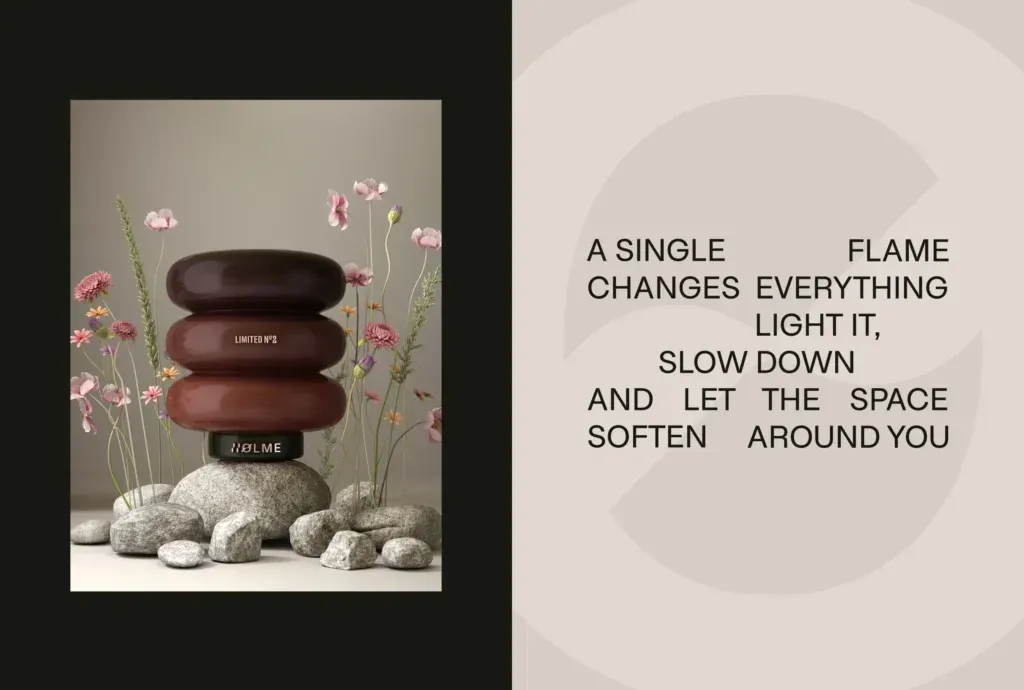
Our Holme case study describes the first kind of thinking: “Sculptural forms, tactile surfaces, and controlled contrasts were studied rather than styled”.
A common mistake is to leave the refill as a plain bag with a sticker. It is the pack the customer buys again, so your brand is seen on it at every repeat purchase. Plan both packs together and begin with 3 decisions:
- Which products are refilled?
- Which refill format does each one use?
- Where does each piece of information sit: on the container, on the refill or on both?
How do you show that both packs are one product?
A customer in front of a shelf, or scrolling a product page, has to see in one look that the refill belongs to the container at home.

4 elements do this work, and they should be identical on both packs:
- The product name and the variant name. Use the same words in the same order and the same typeface.
- The variant colour or mark. Whatever tells one product from the next on the container is repeated on the refill.
- The position of the brand mark in relation to the name.
- The word refill. Give it one fixed place on every refill pack, so the customer learns where to look.
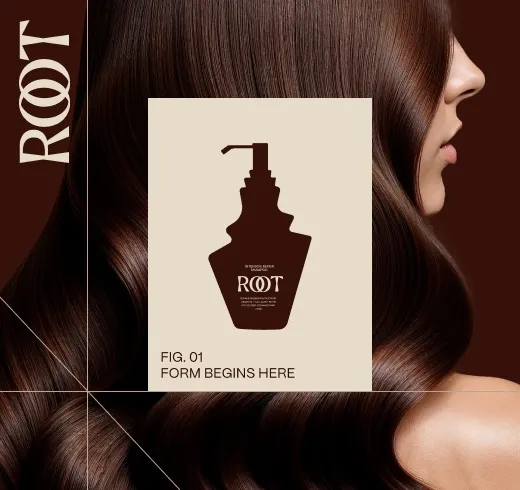
The form of the 2 packs will differ. Our ROOT case study says this about a range of different shapes: “Each silhouette is distinctive while remaining part of the same family”. A pouch and a bottle are 2 silhouettes, and the shared rules make them a family.
Decide what the refill leaves out as well. The brand story and the decorative finish belong on the container. The refill front can be reduced to the name, the variant, the word refill and the volume. Our guide to a packaging system that can grow explains how to write rules like these down before the range gets bigger. What makes the container itself look considered is the subject of our article on cosmetics packaging that looks expensive.
Pouch, cartridge or large bottle: 3 refill formats
Most beauty and skincare refills use 1 of 3 formats, and each gives the designer a different surface to work on.
- A flexible pouch. It has 2 large flat faces, so there is room for a full front and a full information panel. The film creases and changes shape as it empties, and the seals and the spout take area from the edges. Keep small type away from them.
- A cartridge or inner pod. It drops into the permanent container and is often hidden there. The printable area is small and usually curved. Plan for the name, the variant and the batch code on the cartridge, and put the longer text on the carton or sleeve it is sold in.
- A large bottle. It has more label area than the permanent container. The risk is that it reads as a bigger size of the same product. Put the word refill and the volume on the front, where they are seen first.
Ask the supplier for the technical drawing of the chosen format before any artwork starts, because the print area, the seal widths and the spout position come from it. Our comparison of custom and stock packaging covers when a stock format is enough. For type on a creased or curved surface, see how small type can be on packaging.
The table below compares them.
| Refill format | Label area | What to watch in the design |
|---|---|---|
| Flexible pouch | 2 large flat faces, reduced by the seals, the spout and the base fold | Creases and a shape that changes as the pouch empties; keep small type and the batch code area away from seals and folds |
| Cartridge or inner pod | Small and usually curved; often hidden inside the container | Name, variant and batch code on the cartridge; a mark that shows which way it goes in; longer text on the carton or sleeve |
| Carton or sleeve around a cartridge | Flat panels with the most room in the system | Carries the ingredient list and the drawn steps; the front repeats the container’s name, variant colour and mark position |
| Large refill bottle | A full label, larger than the one on the permanent container | Can be mistaken for a bigger size of the product; put the word refill and the volume on the front |
What does the refill pack label have to carry?
A refill pack is sold as a cosmetic product in its own container, so plan it to carry the full label. The list is in Article 19 of Regulation (EC) No 1223/2009, which applies in the EU and, as amended, in Great Britain. It requires the container and packaging to bear the information “in indelible, easily legible and visible lettering”. There are 7 items: the responsible person’s name and address, the nominal content, a durability date or period after opening, precautions, the batch number, the product function and the ingredient list.
Article 19 does not mention refills and gives them no shorter list. Your responsible person or regulatory adviser confirms the wording for each pack.
2 allowances in the article matter for refill formats. The first is about the ingredient list: “This information may be indicated on the packaging alone.” A cartridge sold in a carton can leave the list to the carton. A pouch sold without one carries the list itself.
The second is about the batch number. Where products are too small, the article says “such information need appear only on the packaging”. The GOV.UK guidance for Great Britain states the general rule: “A code which enables the manufacturer or supplier to identify the batch in which the product was manufactured must be marked on both the primary container and outer packaging.”
For the artwork, every refill format needs a clear area for the batch code and the date, which are applied on the filling line.
The batch code that goes out of date on the permanent container
Refilling raises a labelling question that a single-use pack does not have. The permanent container was filled once at the factory and carries the batch code of that first fill. After the first refill, the product inside comes from another batch, and the code on the container no longer describes it.
Neither Article 19 nor the GOV.UK guidance mentions refilling, so these 2 sources do not settle it. The guidance does say what the code is for: it lets the manufacturer or supplier identify the batch. Raise the question with your responsible person early. A layout can then take 1 of 3 routes:
- The code stays with the product. A cartridge sits inside the container until it is empty, so the code on it always matches the contents.
- The code moves across. The pouch carries a peel-off label with the batch code and the date, and the container has a marked panel where the label is placed at each refill.
- The code stays on the refill pack. The pouch tells the customer to keep it until the product is finished.
The period after opening raises a similar question. The guidance says opening may be considered as occurring when the consumer opens the product for use for the first time. Whether a refill starts that period again is for the responsible person to answer.
Draw the refill steps
A refill asks the customer to do something an ordinary pack does not: open 2 packs and move the product from one to the other. Written instructions for this are long, and a refill pack has little room, so draw the sequence.
4 rules keep the drawings usable:
- 3 or 4 numbered steps. Open the container, open the refill, pour or insert, close. If it needs more than 4 drawings, review the mechanism with the supplier.
- One action in each drawing. Show it from the customer’s angle, with an arrow for the movement.
- The line weight of the brand’s other icons, so the steps belong to the pack.
- A position next to the opening. On a pouch that is beside the spout or the tear notch. On a cartridge carton it is the inside of the flap.
Then add the points where a refill goes wrong. For a pouch these are usually where to cut and how far to fill; a fill line on the permanent container answers the second. For a cartridge it is which way up it goes, and matching marks on the cartridge and the container answer that.
Test the drawings with people who have never seen the product. Give them the real pack and no explanation. Our article on testing packaging before launch lists other checks. Precautions for use remain text, in the wording your responsible person supplies.
What EU and UK packaging rules say about reuse
Reuse is also a subject of packaging law. In the EU, the European Commission lists the Packaging and Packaging Waste Regulation, Regulation (EU) 2025/40, as in force since 11 February 2025, with an application date of 12 August 2026. The Commission says: “EU rules on packaging cover all packaging and packaging waste, regardless of material or origin.” Its page names reuse formats among the subjects with mandatory rules and mentions binding reuse targets. It gives no figures for cosmetics refills, so we give none. Your adviser can say which obligations apply to your packs.
In the United Kingdom, Schedule 1 of the Packaging (Essential Requirements) Regulations 2015, read in its original version, sets 3 requirements that reusable packaging has to satisfy simultaneously. The first reads like a design brief: “the physical properties and characteristics of the packaging must enable a number of trips or rotations in normally predictable conditions of use”. The other 2 cover the processing of the used packaging, with its safety requirements for the workforce, and recovery once it is no longer reused.
For a permanent container, that means print that survives repeated washing and filling, a closure that still seals after many openings, and a label that stays flat in a wet room.
Keep environmental figures off the pack unless you hold the evidence. A phrase about less plastic is a claim, and the rules for claims differ by country. Our guide to green claims by market covers what each market asks for.
Designing a refill system with MarkaWorks
A refill system is a packaging project with 2 packs in it, and we run it like our other packaging and product design work. It starts with the structure: the pack format, the material, the closure and the production method, for the permanent container and for the refill. Those decide what the artwork can do.
The range rules come next. A MarkaWorks range has one rule sheet, and the elements that never move are fixed on it before the variants are drawn. The refill pack is one more application of those rules, so we design the container and the refill against the same sheet.
Cosmetics and skincare are a category we work in regularly, and our cosmetics and skincare projects page lists 15 case studies. Your responsible person or regulatory adviser confirms the wording; we design the layout. That includes the clear areas for the batch code and the drawn refill steps.
The container, the refill and any carton are each drawn on the dieline of the partner who produces them, and the working files are handed over.
If you are planning a refill for 1 product or for a whole range, you can work with us on it. Tell us which products you want to refill, and we will reply with a plan for the 2 packs.
Questions brand owners ask about refill packs
Does a refill pouch need its own ingredient list?
Plan for it. Article 19 of Regulation (EC) No 1223/2009 says the list of ingredients may be indicated on the packaging alone, so a refill sold in a carton can carry the list on the carton. A pouch sold without a carton carries it itself.
Where does the batch code go on a refill?
On the refill pack, in a clear area that the filling line can print. The GOV.UK guidance for Great Britain asks for the code on both the primary container and outer packaging, and Article 19 lets it appear only on the packaging where a product is too small.
Should the refill pack look the same as the main container?
It should be recognised as the same product, which does not require the same shape. Keep the product name, the variant colour and the position of the brand mark identical, and add the word refill in one fixed place.
Can we print how much plastic the refill saves?
Only with evidence that supports the figure in each market where the pack is sold. A statement about less plastic is an environmental claim, and the rules for such claims differ by country.
More brands we brought to life: