A pet food brand earns owner trust by making 3 things easy to check on the pack: what is inside, who makes it and how to reach them, and what each claim rests on. Pet food labels are regulated in the US and the UK, so the identity is built inside the labelling rules and makes the required facts easy to read.
Trust starts with what the owner can check
A pet owner buys food for an animal that cannot say what it thinks of it, so the pack has to answer the owner’s questions instead. The brand earns trust in the places the owner can check: the ingredients, the maker, the instructions and the claims.
That makes pet food branding different from branding a product the buyer consumes. The design job is to make the checkable facts easy to find and easy to read, and then to give the brand a character that owners remember. A strong character on a pack that hides its facts reads as marketing; a clear pack with a weak character is forgettable.
This article covers the US and UK label rules, the claims a brand may make, the way an identity can put the ingredients forward, and the system that keeps a range consistent. If you are deciding what makes your brand different before any of this, our guide to positioning a product brand sets out the 4 decisions to make first.
What the US rules require on the label
In the US, the Food and Drug Administration’s page on pet food sets the baseline. It states that the Federal Food, Drug, and Cosmetic Act “requires that all animal foods, like human foods, be safe to eat, produced under sanitary conditions, contain no harmful substances, and be truthfully labeled.”
On labelling, the same page says: “Pet food labeling is regulated at two levels. The current FDA regulations require proper identification of the product, net quantity statement, name, and place of business of the manufacturer or distributor, and proper listing of all the ingredients in the product from most to least, based on weight.” It adds the second level: “Some states also enforce their own labeling regulations.”
For the brand, that gives 4 fixed elements on every US pack: the product identity, the net quantity, the maker or distributor with their place of business, and the ingredient list in weight order. A pack system that gives each of the 4 a fixed position, in a readable size, lets the owner find the same facts in the same place on every product in the range.
What the UK rules require on the label
In the UK, pet food is covered by the retained version of Regulation (EC) No 767/2009 on the marketing and use of feed. Article 11 sets the principle: “The labelling and the presentation of feed shall not mislead the user”. It names the ways a label can mislead, including “by attributing to the feed effects or characteristics that it does not possess or by suggesting that it possesses special characteristics when in fact all similar feeds possess such characteristics”.
That second limb matters for branding. A pack that presents an ordinary property of every food in the category as if it were special is misleading under this article, even if the property is true. The difference has to be 1 the category does not already share.
Article 17 lists specific particulars for compound feed, starting with “the species or categories of animals for which the compound feed is intended” and “the instructions for proper use indicating the purpose for which the feed is intended”. Article 19 adds a requirement only for pet food: “On the label of pet food a free telephone number or other appropriate means of communication shall be indicated in order to allow the purchaser to obtain information in addition to the mandatory particulars” on the feed additives and the feed materials designated by category.
That last rule is a branding opportunity as much as a duty. The contact route is a place where the brand can speak to an owner directly, so we give it a fixed, readable position in the pack layout.
Claims: what they need before they go on the pack
Claims are the part of the pack the rules restrict most closely. In the UK, Article 13 of the same regulation allows a label to “draw particular attention to the presence or the absence of a substance in the feed, to a specific nutritional characteristic or process or to a specific function related to any of these”, on conditions.
The conditions are specific: “the claim is objective, verifiable by the competent authorities and understandable by the user of the feed”, and the person responsible for the labelling provides, on request, “scientific substantiation of the claim, either by reference to publicly available scientific evidence or through documented company research.” The article sets the timing: “The scientific substantiation must be available at the time the feed is placed on the market.” It also states the consequence: where a claim “is not sufficiently substantiated, the labelling in respect of such claim must be considered misleading for the purposes of Article 11.”
In the US, the FDA page notes that the agency “also reviews specific claims on pet food”. For both markets, the working rule for the brand is the same: write the claims list before the pack design starts, attach the evidence to each claim, and keep anything without evidence off the pack. This article describes the rules; whether a particular claim is permitted in a particular market is a question for a regulatory specialist before print.
Put the ingredients forward in the design
The facts the rules require can also carry the design. An owner who wants to know what is inside should be able to see it on the front of the pack.
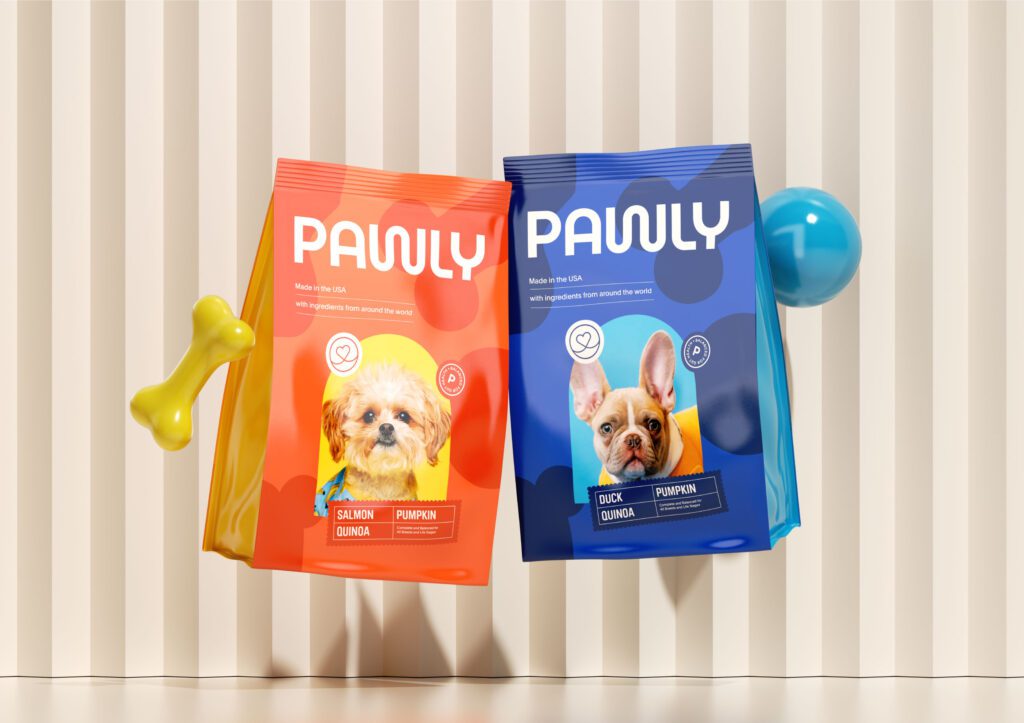
For Pawly, a dog food brand, we built the packaging around that idea. The case study describes it: “Each package features a label-style stamp that showcases the 3-4 main ingredients, empowering pet owners to make informed decisions about their dog’s nutrition.” The same page states the purpose in the brand’s own terms: the packaging “highlights key ingredients through a distinct label-style stamp. This empowers pet owners to make informed choices while celebrating the joy of dogs through a unique visual identity.”
The stamp does 2 jobs at once. It answers the owner’s first question on the front of the pack, and it becomes a recognisable element of the identity, the same shape on every product with different contents.
If the ingredient story is the brand’s difference, the front-of-pack element should repeat what the full ingredient list says, in the same order and the same names, so that the 2 can never disagree. The full list, in weight order on a US pack, stays where the rules put it.
Give the brand a character owners remember
Trust gets the brand considered. Owners also choose a food because the brand feels like it understands them and their animal, and that part comes from the identity.

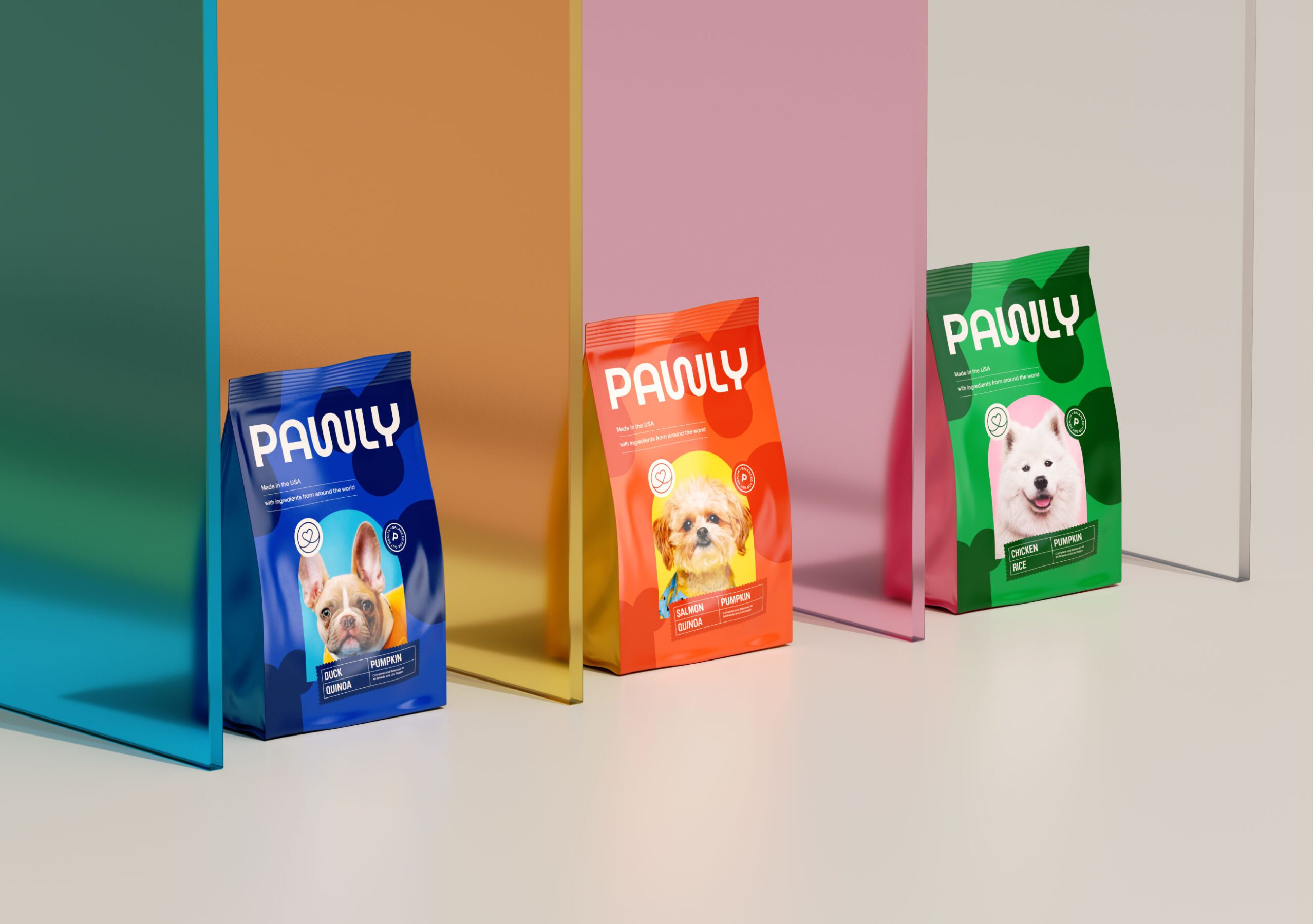
Pawly’s identity balances 2 qualities that can pull apart. The case study says the logo “integrates playfulness and minimalism, creating a unique visual identity that reflects the joy found in dogs. This approach ensures the brand is both approachable and sophisticated.” The packaging adds colour: “The vibrant packaging design adds a touch of whimsical joy.” The delivered scope on the page lists “Branding, Packaging Design, Art Direction, 3D Scene Creation”.
Let the character live in the parts the rules leave free: the logo, the colour build, the illustration or photography style, the tone of the copy on the front. The required panels stay calm and readable. A playful brand can still have a plain, well-set ingredient list, and the contrast shows the owner that the brand takes the facts seriously.
Our brand strategy and visual identity page describes the method we use for every category: “Strategy here means four decisions made in order.” For pet food, the fourth of those decisions, what the brand must never say, is the one the labelling rules shape most.
Keep the system honest across the range
Pet food ranges grow by recipe, animal, life stage and pack size. Each new product can make the brand drift: a new claim that the evidence does not cover, an ingredient element that no longer matches the list, a contact route that moves.
A range system stops that drift by fixing 3 things. The position of every required element, the same on every pack in the family. The rules for the ingredient element, including what it may show and how it matches the full list. And the claims list, with the evidence each claim rests on, held with the brand guidelines rather than in a designer’s memory.
Our article on packaging a range across many variants, sizes and formats covers the structure that lets a range extend without being redrawn. The same principle applies here, with 1 addition: in pet food, the fixed structure is also the place where the regulated facts live, so a consistent layout is part of how the brand stays inside the rules. Our packaging and product design page sets out how that structure is built and handed over for print.
| Element | Source of the requirement | Brand opportunity |
|---|---|---|
| Product identity and species | FDA page (US); Article 17 (UK) | A fixed place and a clear name per recipe |
| Net quantity | FDA page (US) | A fixed position across all pack sizes |
| Maker or distributor | FDA page (US) | The brand’s origin, stated plainly |
| Ingredients in weight order | FDA page (US) | A front-of-pack element that matches the full list |
| Instructions for use | Article 17 (UK) | Readable feeding guidance in the brand’s tone |
| Contact route for more information | Article 19 (UK) | A designed place where the brand speaks to owners |
| Claims | Article 13 (UK); FDA reviews specific claims (US) | Only what the evidence on file supports |
How MarkaWorks works on pet food brands
MarkaWorks is a branding agency for product brands, and our pet food work starts from the facts on the pack before the character of the brand, as the Pawly identity shows. On a pet food project, the order is the one set out above. First the position and the claims list, with evidence attached. Then the identity, with the character placed in the parts the rules leave free. Then the pack system, with fixed places for the product identity, the quantity, the maker, the ingredients, the instructions and the contact route. The final check of a label against the rules of each market belongs to a regulatory specialist, and we plan the files so that check is quick.
When you are choosing who should do the work, our guide to choosing between a branding agency and a freelance designer sets out the 4 questions, and our guide to comparing branding proposals beyond the price shows how to read a proposal’s scope. To talk through your range, your markets and what owners should see first, start from our contact page.
Questions brand owners ask about pet food branding
What makes pet owners trust a pet food brand?
Facts they can check: what is inside, who makes it and how to reach them, and what each claim rests on. The identity makes those facts easy to find, then gives the brand a character owners remember.
What must a US pet food label show?
The FDA says current regulations require product identification, a net quantity statement, the maker or distributor and place of business, and all ingredients listed from most to least by weight. Some states add their own rules.
What does UK law add for pet food?
Among other particulars, Article 19 of the retained Regulation 767/2009 requires a free telephone number or other appropriate contact route on the label, so the buyer can get more information on additives and feed materials.
Can a pet food brand make claims on the pack?
In the UK, under conditions: the claim must be objective, verifiable and understandable, and scientific substantiation must be available when the food is placed on the market. Check each claim with a regulatory specialist.
Can a pet food brand still be playful?
Yes. The character lives in the logo, colour, illustration and front-of-pack tone, while the required panels stay calm and readable. Pawly combines playfulness and minimalism this way.
Show what is inside before you say what it does, keep every claim inside the labelling rules, give the owner a way to ask, and design a system that stays honest across the range.
More brands we brought to life: