Choose by what the tea must be kept from and where it will sell. Moisture is the main cause of quality loss in stored black tea, so the seal comes before the material. A tin protects and refills, a pouch ships light, and a box needs a sealed inner bag. Plain tea needs no nutrition declaration under Annex V of Regulation 1169/2011.
What the pack has to keep out
Start with the tea, because the pack exists to protect it. A review of black tea storage from the Tea Research Institute of Sri Lanka, indexed by the FAO AGRIS database, states: “The principal agent catalysing these changes has been identified as moisture.” The same 1982 review ties the loss of quality to a fall in theaflavins and recommends humidity control at the grading and packing stages.
So the first packaging question is a practical one. How well does the closure seal, and how well does the material resist humid air between the day the tea is packed and the day the last spoonful is used? A beautiful box with a loose lid fails that test. A plain pouch with a good zip can pass it.
The review covers black tea. If you sell green, white or flavoured blends, ask your tea supplier what they recommend for storage.
Tin, pouch or box: what each format does
Each format solves a different part of the problem, and a range can combine two of them. The table below compares them on the points a brand owner decides on. It describes how the formats behave in use; it is not a test result, and the barrier performance of any specific pack should come from your packaging supplier’s specification.

| Format | What it does well | What to watch | Where it fits |
|---|---|---|---|
| Tin | Rigid, reusable, holds a premium shelf position | Lid fit and any inner seal decide the moisture protection | Gift sets, flagship blends, refill programmes |
| Stand-up pouch | Light to ship, flexible print area, can carry a resealable zip | Layered films complicate a recycling claim | Online orders, trial sizes, refills for a tin |
| Box with inner bag | Large flat panels for the brand and the label | The paperboard needs a sealed inner bag to protect the tea | Retail shelves, multi-blend ranges |
| Tin with pouch refill | Keeps the tin in use and lowers what ships each time | Two packs to design as one system | Subscriptions and repeat buyers |
What the label still has to carry
Whatever the format, the required information has to fit on it. In the UK and the EU, Article 9 of Regulation (EU) No 1169/2011 lists the mandatory particulars, starting with “(a) the name of the food” and “(b) the list of ingredients”, and running through net quantity, the date of minimum durability and the name and address of the business.
Article 13 sets the size: an x-height of at least 1,2 mm, or 0,9 mm when the largest surface of the pack is under 80 cm². A small sample pouch reaches that lower limit quickly, so check the panel size before the design is drawn. The measurement is explained in how small the type on your packaging can be.
Annex V, item 8, removes the nutrition declaration for “tea, decaffeinated tea, instant or soluble tea or tea extract” and herbal and fruit infusions without added ingredients beyond flavourings. In the US, 21 CFR 101.9(j)(4) gives a similar exemption and names tea leaves as an example, provided the food bears no nutrition claims. That condition makes front panel wording a labelling decision as well as a brand one.
How a range of blends stays easy to sort
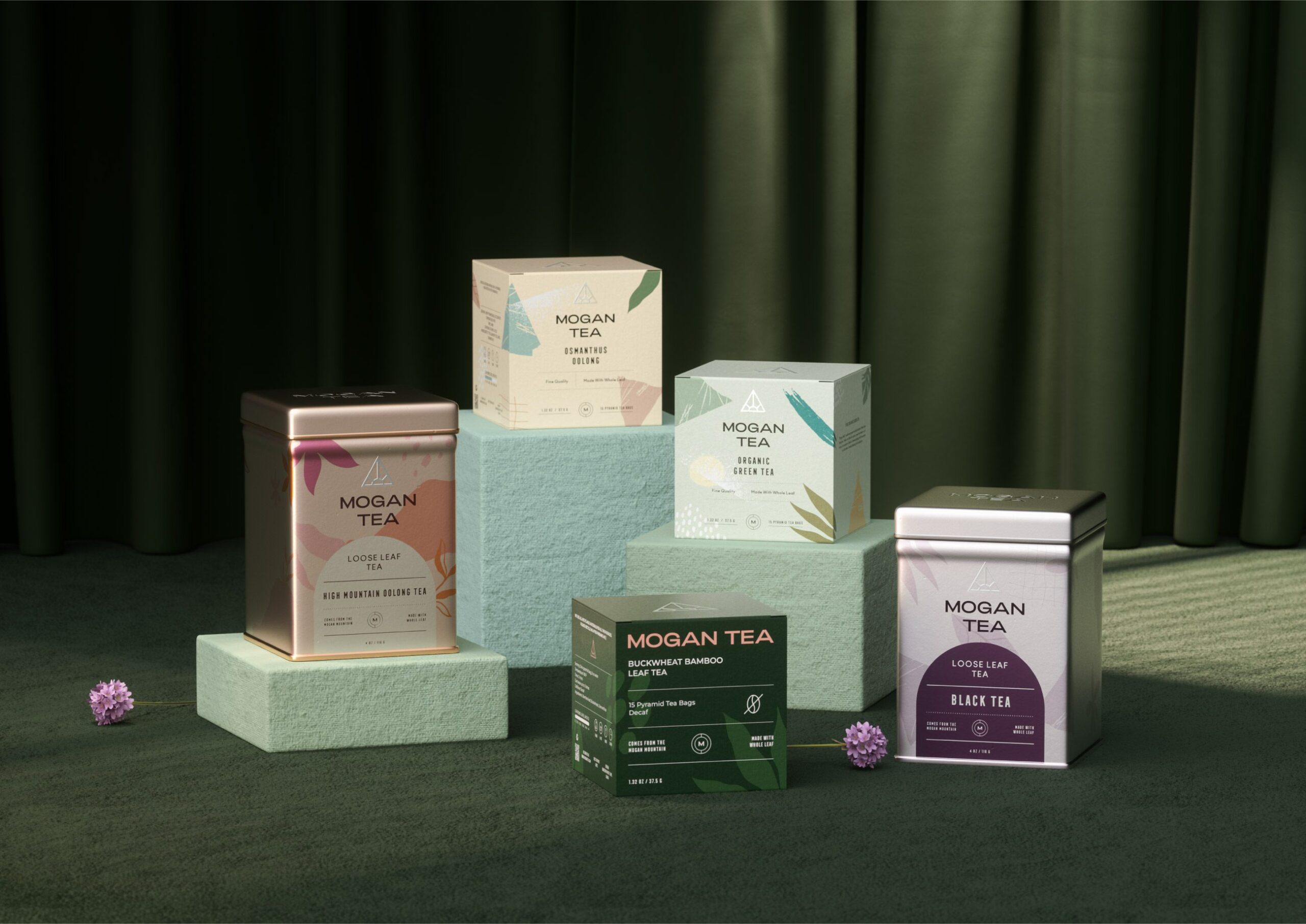
Once there is more than one blend, the pack also has to tell them apart. The MarkaWorks tea projects show four ways to build that system.
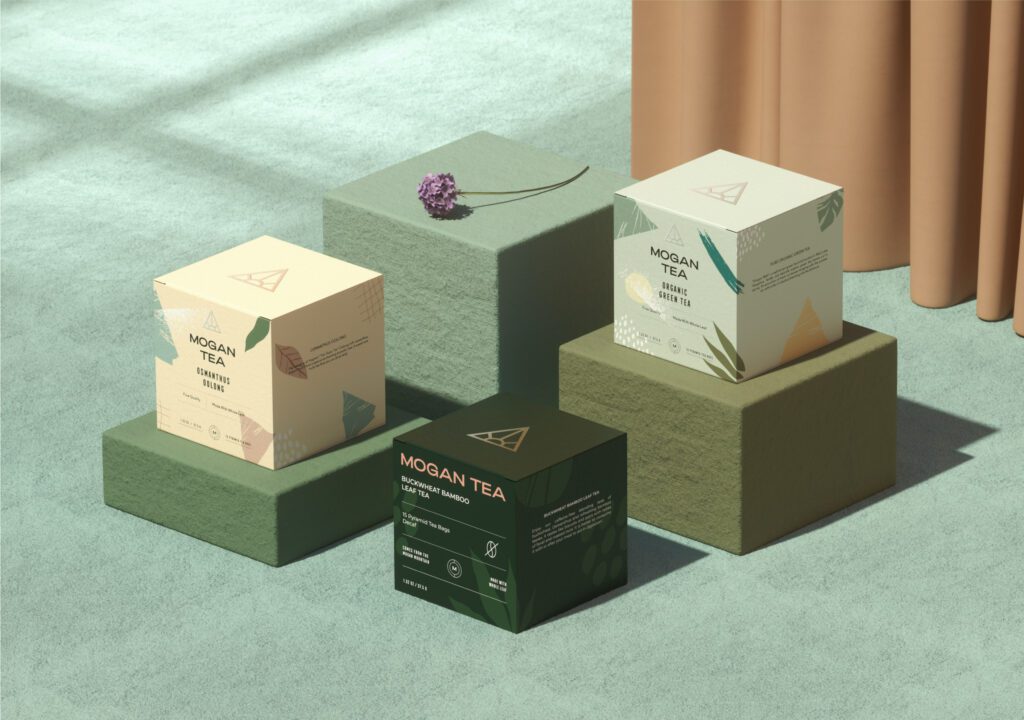
- On Mogan Tea, the label follows a fixed order: “Tea type, flavor profile, and brewing guidance sit in a fixed order”, so the buyer reads every variant the same way.
- On Sophia’s Tea, each flavour has its own pattern, and the palette pairs each soft colour with a brighter counterpart so the range stays one family.
- On YU, each tea gets its own colour family, with one accent for Matcha and another for Hojicha.
- On Her ProperTea, a muted palette does the work of separating the blends, with generous spacing and little on the pack.
The common thread is a decision taken before the first label: what changes from blend to blend, and what stays fixed. Colour alone runs out as the number of blends grows, so the position of each element has to carry part of the system.
Where brewing guidance goes
Loose leaf tea has to be brewed, so the pack is the obvious place for the guidance. Article 9(1)(j) of the regulation requires instructions for use “where it would be difficult to make appropriate use of the food in the absence of such instructions”. Whether a given tea falls under it is a question for your labelling adviser, and brewing guidance is the obvious candidate.
Give it a fixed position across the range, at the same size and in the same order, so a returning buyer knows where to look. On a tin, that usually means the back or the base. On a pouch or a box, it sits beside the mandatory panel, where the eye already goes for practical information.
Recycling claims on a tea pack
A recycling message is easy to overstate. In the US, the FTC Green Guides at 16 CFR 260.12 say an unqualified recyclable claim needs recycling facilities available to a “substantial majority” of consumers, defined as “at least 60 percent”. The same section asks for a clear qualification when only some components are recyclable.
That applies to any tea pack built from more than one material: a tin with a plastic lid, a box with a film inner bag, a pouch made of layered materials. Decide which component the claim covers before the artwork is drawn. The UK and EU side is set out in what you can say about recycling and the environment, market by market.
What to decide before briefing a designer
A tea packaging project moves faster when these points are settled first:
- The formats you are committed to, and the fill weights for each.
- The markets you sell into, because the strictest one sets the label size.
- The number of blends today and the number you expect next year.
- Where the tea will sell: retail shelf, your own online shop, or both.
- Whether a refill or subscription model is part of the plan.
The rest is in what to prepare before a packaging project starts, and the coffee and tea case studies show how these decisions played out on 20 published projects. When the answers are ready, MarkaWorks can design the packaging and label system once and apply it to every blend you add.
What this article does not settle
We have quoted the moisture finding for black tea only. We have not verified storage figures for green, white or flavoured tea, or barrier figures for specific materials, and those should come from your tea supplier and your packaging supplier.
The label rules above are the UK and EU regulation and the US federal rule. A retailer’s pack specification can ask for more than the law does, and a second market can change the label again, as what changes on the label when you enter a second market explains.
Questions tea brands ask
Is a tin or a pouch better for loose leaf tea?
Neither wins on its own. A tin is rigid, reusable and suits a premium shelf position, while a pouch is lighter to ship. In both cases the closure and the seal decide how well the tea is kept from moisture.
Does loose leaf tea need a nutrition label in the UK?
Usually not. Annex V, item 8, of Regulation 1169/2011 lists tea and herbal or fruit infusions with no added ingredients beyond flavourings among the foods for which the nutrition declaration is not mandatory, under Article 16(3).
How large does the text on a small tea pouch have to be?
The mandatory particulars need an x-height of at least 1,2 mm, or 0,9 mm when the largest surface of the pack is under 80 cm², under Article 13 of Regulation 1169/2011.
Can a tea tin be labelled recyclable in the US?
Only if the claim fits the FTC Green Guides. An unqualified claim needs recycling facilities for at least 60 percent of consumers, and a tin with a plastic lid needs the claim qualified for the parts that are recyclable.
Where should brewing instructions go on tea packaging?
In a fixed position that repeats across the range, usually the back or the base of a tin, or beside the mandatory panel on a pouch or box, so a returning buyer finds them without searching.
If you are planning a tea range, send the formats, markets and blend list through our contact page and we will start from the label system.
What the pack has to keep out, what the label still has to carry, and how a range of blends stays easy to sort.
More brands we brought to life: