Pick the format for how the coffee will be sold, then settle the barrier and the valve. Freshly roasted coffee keeps releasing gas, mostly carbon dioxide, so the common coffee bag carries a one-way valve to stop pressure building up. In a 2014 Zurich study, packs with an aluminium layer protected roasted beans better over 57 weeks.
Why a coffee bag needs a valve
Roasting fills the bean with gas, and the bean lets it out slowly. A 2018 study from the Zurich University of Applied Sciences, published open access in the Journal of Agricultural and Food Chemistry, explains that part of the gas formed in roasting stays in the porous structure of the beans and “is steadily released during storage or more abruptly during grinding and extraction”. It cites earlier work that put carbon dioxide at 87% of the gas released when whole beans are ground.
The same paper describes “the most common coffee packaging format, which includes a one-way valve for release of gas from inside the packaging”, so that pressure does not build up in the bag. The gas still does some work inside the bag: the authors note that its release “creates a protective atmosphere in packaging”.
For a brand owner, the valve is a design element as much as a technical one. It is a small round fitting set into one of the panels, and the artwork has to leave space for it. Ask your packaging supplier where the valve sits on the bag you are quoting before the layout is drawn.
Whole bean or ground: what changes for the bag
The two products behave differently once packed. In the Zurich measurements, freshly ground coffee released gas at up to 40 mg per hour for a 12 g sample in the first hours, against up to 2 mg per hour for 15 g of freshly roasted whole beans. The paper sums it up as “much faster release rates for ground coffee at shorter times, but lower overall degassed amount” compared with whole beans.
That difference matters when one range carries both. A whole bean bag and a ground bag of the same coffee can share a design while needing different decisions on packing time, valve and barrier. Those decisions belong to your roaster and your packaging supplier, so bring their answers to the design brief rather than leaving the designer to guess.
The study also found that roast degree and roast speed change the amount and pace of degassing. If your range runs from light to dark roasts, ask whether one bag specification is meant to serve all of them.
Stand-up pouch, flat bottom, side gusset or tin
Each bag format gives the design a different set of panels to work with, and each suits a different way of selling. The table below compares the four formats a coffee brand most often weighs. It describes how the formats behave in use; it is not a test result, and the barrier performance of any specific bag should come from your supplier’s specification.
Print run size narrows the choice as well, because some formats and print methods carry tooling costs that only pay back over large quantities. That side is covered in which printing method suits how many units.
| Format | What it does well | What to watch | Where it fits |
|---|---|---|---|
| Stand-up pouch | Stands on a shelf, large front panel, can carry a zip | Valve and zip both take space on the panels | Online shops, smaller bag sizes |
| Flat bottom bag | Stands square, gives side panels and a base for information | More complex construction; confirm minimum order with the supplier | Retail shelves, premium ranges |
| Side gusset bag | Simple folded bag with narrow side panels | Reclosing needs a zip, a tin tie or a clip | Larger bags, cafés, wholesale |
| Tin or can | Rigid and reusable, strong shelf presence | Ask how the lid handles gas from freshly roasted coffee | Gift sets, subscriptions, refill programmes |
What the barrier layer does
The valve handles gas leaving the bag; the material decides how well the bag holds aroma in and keeps air out. A 2014 study published in the Swiss journal CHIMIA stored 250 g of freshly roasted whole beans in four packaging materials at room temperature for up to 57 weeks: a paper bag, a paper and plastic laminate, a laminate with a thin aluminium layer and one with a thicker aluminium layer. All except the paper bag were fitted with valves.
The authors tracked ratios of aroma compounds as freshness markers and concluded: “Packaging materials that contain an aluminum layer offer better protection.” For one of those ratios, the difference between packs with and without aluminium was already significant after two weeks.
A paper bag with a kraft finish looks artisanal, but the 2014 study puts it at the low end of protection. A laminate with an aluminium layer protects better, and it is also a layered material, which is harder to describe as recyclable. For the claim itself, see what you can say about recycling and the environment, market by market. Decide which matters more for each product before choosing the finish.
What goes on the front, and what goes on the back
The front panel has one job: help a buyer pick this coffee over the one beside it. On the Caffeinication project MarkaWorks built the type system for hierarchy first, because “a coffee label has to carry roast level, origin, and tasting notes in a small area, and a buyer comparing two bags is looking for the same three things in the same order.” Across the MarkaWorks coffee projects, the front carries the brand mark, the coffee name, the origin and the roast level.
The mandatory information still has to fit somewhere, and a valve and a zip both take panel space. In the UK and the EU, Article 13 of Regulation (EU) No 1169/2011 sets an x-height of at least 1,2 mm, or 0,9 mm when the largest surface is under 80 cm². Annex V, item 7, lists “whole or milled coffee beans” among the foods that need no nutrition declaration, and in the US 21 CFR 101.9(j)(4) names “coffee beans (whole or ground)” in a similar exemption. The full required list, and the order to set it in, is in what should be on a coffee bag label.
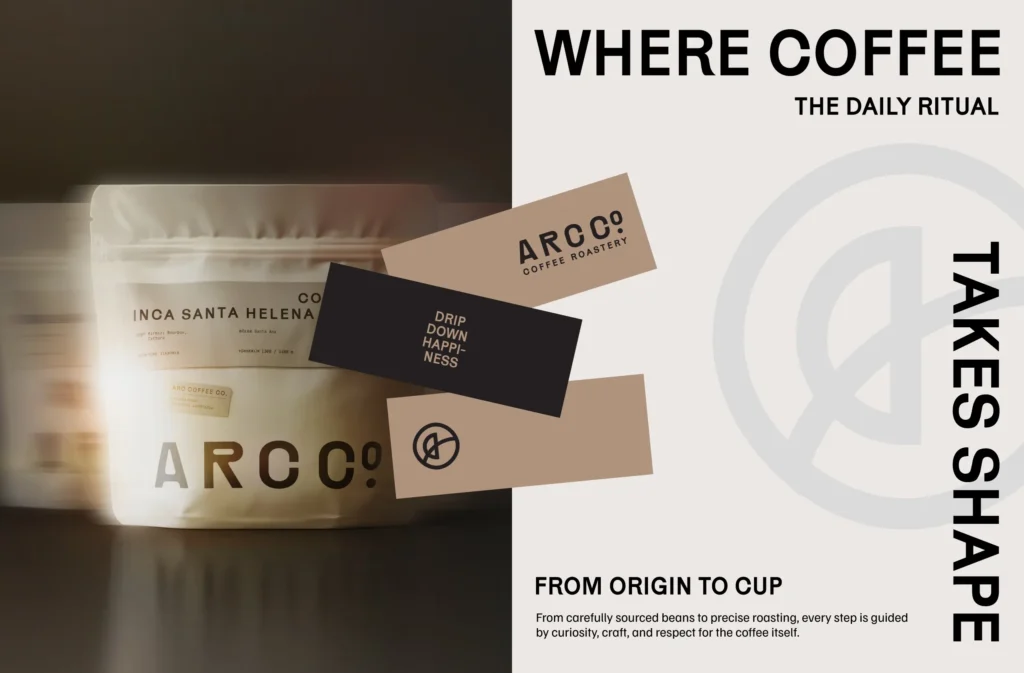
Material is part of the front as well. For Caffeinication we used “textured surfaces, metallic details, and warm gradients”, because a specialty coffee bag is picked up before it is bought. On Herschel’s Coffee Co., the bag has a blue background with striped patterns on the sides and a label on vintage textured paper carrying the coffee name and type.
How a range of origins stays readable
Once a brand sells more than one origin, the bag has to work as a system. The coffee projects show four ways to keep that system readable as it grows.
- On Roadster Coffee, the packaging uses a modular label system: origin, roast and profile each have a fixed place, green panels hold the range together and the cream base carries the differences between blends.
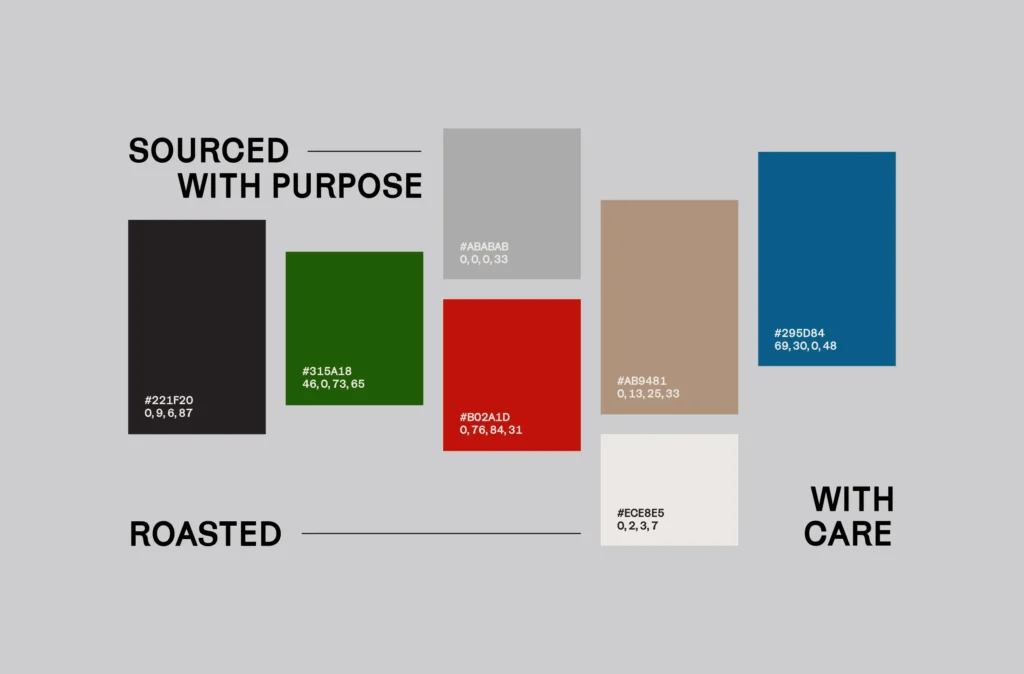
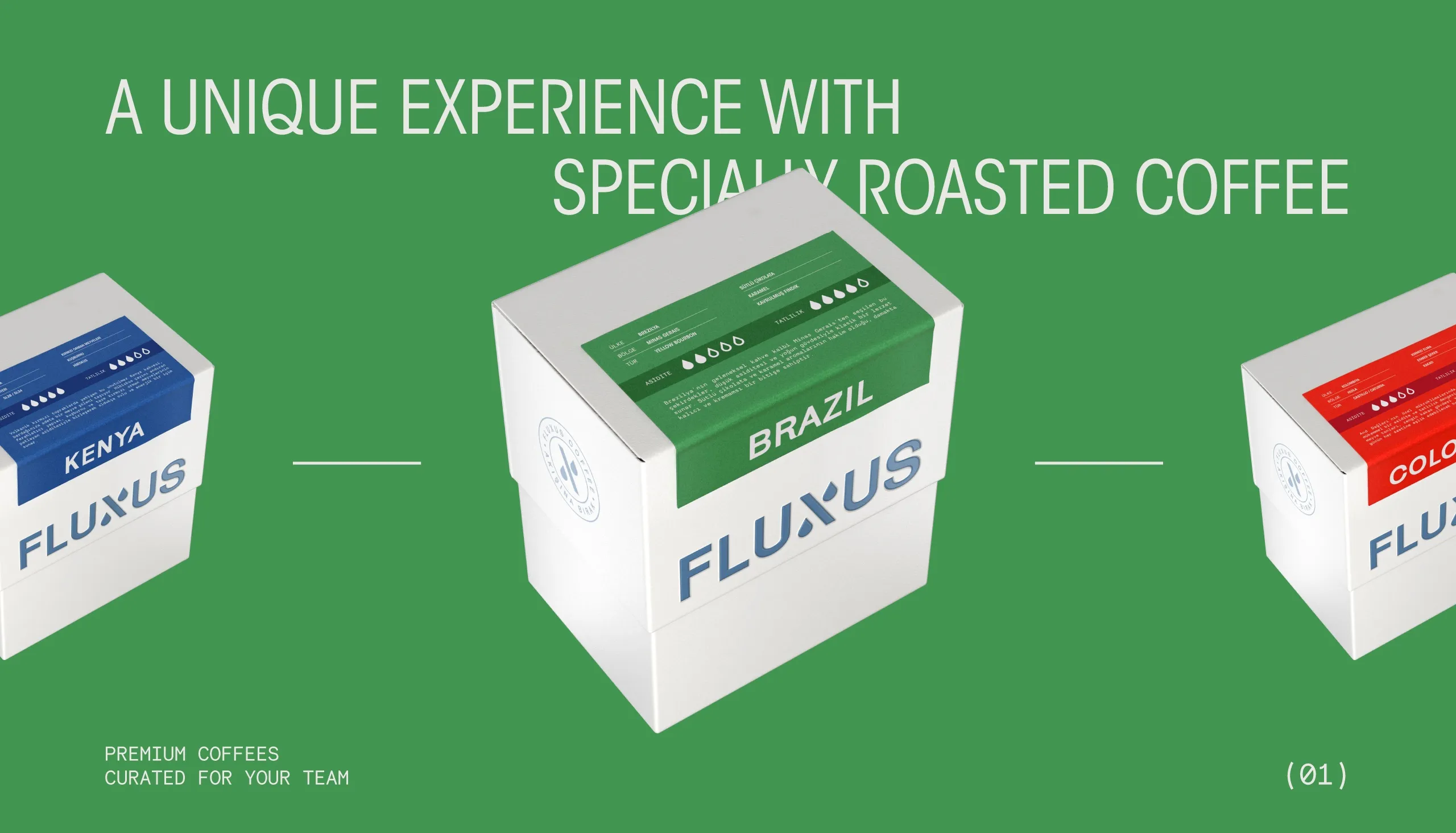
- On Fluxus Coffee, the label answers two questions at once, which coffee this is and whose coffee it is. Difference between coffees is carried by colour and pattern, so “a new origin enters the system without a new design”.
- On The Supreme Roastering Co., the upper part of the bag is dark green with the logo, and the lower part is patterned, with a label carrying the flavour, name and the rest of the coffee information.
- On Drop Co. Coffee Roasters, the bag has a white background and a blue label, and the flavour sits in its own colour box.
In each case the fixed part of the bag is decided before the first origin is designed. The Caffeinication case starts from the observation that kraft paper, hand lettering and origin stories no longer separate one specialty bag from another, so the system has to come from structure, colour and finish.
What to settle before the bag is designed
A coffee packaging project moves faster when these points are settled first:
- Whole bean, ground or both, and the bag sizes for each.
- The bag format, with the valve position and any zip confirmed by your packaging supplier.
- The barrier material, and whether a recycling message is part of the plan.
- The markets you sell into, because the strictest one sets the type size.
- The number of origins today and the number you expect to add in a year.
- Where the coffee sells: your own café, your online shop, retail shelves or wholesale.
Before committing to a print run, check the bag with buyers; how to test packaging design before launch describes how. The coffee and tea case studies show the full projects, and if you sell tea alongside coffee, the tea side is in choosing packaging for loose leaf tea. Those answers are what the packaging and label system is built from; in a MarkaWorks coffee project it is set once and reused for every origin added later.
What we have not checked
The figures quoted here come from laboratory studies. The 2014 storage study used one Arabica coffee from Guatemala in 250 g packs, and the 2018 degassing study measured small samples under controlled conditions. Neither gives a shelf life or a valve specification for your coffee.
We have not verified barrier figures for any specific bag material, valve opening pressures or resting times between roasting and packing. Those should come from your roaster and your packaging supplier, tested on your own coffee and bag.
Questions coffee brands ask
Do coffee bags need a one-way valve?
Freshly roasted coffee keeps releasing gas, mostly carbon dioxide. A 2018 Zurich study describes the most common coffee pack as one with a one-way valve that lets this gas out so pressure does not build up. Ask your roaster how fresh the coffee will be when it is packed.
Does ground coffee need a different bag from whole beans?
It behaves differently in the bag. In the 2018 measurements, ground coffee released gas much faster in the first hours but less in total than whole beans. The design can be shared, while packing time, valve and barrier are set for each product.
Which material keeps roasted coffee fresh longest?
In a 2014 study of four materials over up to 57 weeks, packs with an aluminium layer protected roasted whole beans better than paper or a paper and plastic laminate. Ask your supplier for the barrier specification of the exact bag you are quoting.
Does a coffee bag need a nutrition label in the UK or EU?
Usually not. Annex V, item 7, of Regulation 1169/2011 lists whole or milled coffee beans among the foods for which the nutrition declaration is not mandatory. The other required particulars, such as the name, net quantity and durability date, still apply.
What should go on the front of a coffee bag?
The brand mark, the coffee name, the origin and the roast level, in the same order on every bag in the range, with tasting notes where they help a buyer choose. The mandatory block can sit on the back or a side panel, at a readable size.
If you are planning a coffee range, send the bag formats, markets and origin list through our contact page and we will start from the front panel system.
Why roasted coffee needs room to breathe out, how the bag formats differ, and how the front panel stays readable across a range.
More brands we brought to life: