Rebrand a product without wasting printed packaging by counting the stock by product and stage, deciding which brand elements must survive, and phasing the new pack in as each product’s stock runs down. Under GS1 rules, a change to the primary brand on the pack requires a new GTIN, so plan barcodes and retailer listings before the switch date.
Count what is already printed, product by product
A rebrand plan starts with a stock list, not a design. Printed packaging sits in more places than the warehouse, and each place has its own timing. A useful list has 4 columns for every product and every packaging component:
- What is printed: cartons, labels, sleeves, pouches, inserts, shipping boxes.
- Where it is: at the printer, at the co-packer or filler, in the brand’s warehouse, or already on retail shelves.
- What is on order but not yet printed, and whether that order can still be changed.
- When each item is expected to run out at the current rate of sale.
The last column is the one that sets the plan. A product that runs out next month and a product with stock for a year cannot switch on the same day without one of them wasting packaging. The list also shows which components are shared across products, such as a shipping box or a common back label, because those change once for the whole range.
The brand owner holds these numbers; the agency does not. The design schedule is then built backwards from the run-out dates, so new artwork is ready when each product needs it rather than all at once.
Decide which brand elements must survive
The second step is deciding what the rebrand keeps. The more a new pack shares with the old one, the easier it is to run both on shelf during the change, and the less the buyer has to relearn.

Our brand strategy and visual identity page puts the risk plainly: “A rebrand is the one project where the risk is subtraction.” It describes how we start: “Our rebrand work starts by listing what must survive: the elements a buyer uses to find the product, the pages that already earn visits, the names people search. Everything outside that list is open.”
For packaging, that list can include the product name, the main colour that marks each variant, the position of the brand mark and the structure of the information panel. Keeping those fixed while the typography, illustration or logo drawing changes lets an old pack and a new pack sit side by side without looking like 2 different brands. It also tells the designer where the freedom is.
If the brand is not sure whether it needs a new identity at all, our article on a new logo or better packaging sets out how to tell which one the problem is.
Check what the change triggers for barcodes
Some pack changes trigger new product identifiers, and those affect retailer listings and stock control. The GS1 GTIN Management Standard sets the rules brand owners follow for GTINs, the numbers behind retail barcodes.
The most relevant rule for a rebrand is the one on the primary brand. GS1 defines it as “the brand most recognisable by the consumer, as determined by the brand owner, and can be expressed as a logo and/or words”, and states: “A change to the primary brand that appears on the trade item, requires assignment of a new GTIN.”
Other rules apply when the rebrand changes more than the look. GS1’s rule on declared net content says: “Any change (increase or decrease) to the legally-required declared net content that is printed on the pack, requires assignment of a new GTIN.” Its rule on new product introduction states: “Any new product requires the assignment of a GTIN”.
The planning consequence is direct. Where a new GTIN is needed, the old packs and the new packs are different trade items for the retailer, so the brand needs the new numbers, the retailer’s listing process and a switch date per product before the new artwork goes to print. Whether a specific change needs a new GTIN is checked against the GS1 rules or with the brand’s GS1 member organisation.
Keep the mandatory information right on old and new packs
During a phased change, 2 versions of a pack are on sale at once, and both have to carry the information the market requires. In the UK, Article 9 of Regulation (EU) No 1169/2011 as published on legislation.gov.uk lists 12 mandatory particulars for food, starting with “the name of the food” and “the list of ingredients”.
This matters most when a brand considers covering old packs instead of reprinting them. Article 13 of the UK text says mandatory food information “shall be marked in a conspicuous place in such a way as to be easily visible, clearly legible and, where appropriate, indelible”, and that it “shall not in any way be hidden, obscured, detracted from or interrupted by any other written or pictorial matter or any other intervening material.” So a sticker or sleeve with the new brand has to leave that information fully visible.
The same applies in reverse: the new artwork must carry every particular the old pack carried, in a legible size, before it replaces the old pack. Our article on how small type can be on packaging covers the legibility side. Where a product carries regulated category wording, as olive oil does, our article on olive oil packaging design shows how those words set the label hierarchy. This article does not give a legal opinion on a specific pack; that check belongs to the brand owner’s adviser for each market.
Choose how to phase the new pack in
With the stock list and the triggers known, the brand can choose how the new pack enters. This article sets out 3 routes, and a range can use more than 1 of them.
The first is to sell through the old stock and switch on a single date. It fits a small range where the run-out dates are close together, and it gives the cleanest shelf.
The second is to switch product by product as each one runs out. It uses all of the printed stock, at the price of a period in which the range shows 2 designs. This route works best when the elements that must survive are kept fixed, so the old and new packs still read as 1 family.
The third is to adjust only what has not yet been printed. Orders that are still open at the printer get the new artwork; printed stock sells through. It suits a rebrand that keeps the structure and changes the surface, and it depends on the printer’s timing, which our article on printing method and minimum order explains.
Whichever route is chosen, write the switch date for every product and every component into 1 shared schedule, and agree it with the printer, the co-packer and the retailers that need notice.
Design the new pack to sit next to the old one
A rebrand that has to share a shelf with its predecessor is designed differently from a launch. The new system needs to be clearly new and still recognisable as the same product, at least for the length of the change.

The practical method is to keep the pack’s structure and change its surface: the same dieline and format, the same information block in the same position, the same colour coding for variants, with new typography, illustration or brand mark drawing. Keeping the dieline also avoids new cutting tools.
Our packaging and product design page describes the starting point we use for this: “We audit the existing identity for print behaviour first, because marks drawn for screen often need a production variant, and then build the pack system to it.” It also states that “We prepare production artwork to the production partner’s own dieline and specification, so the files arrive in the form their production team expects.”
A system built this way also makes later additions easier. Our article on a packaging system that can grow with your brand covers how constant and variable elements are set once for a whole range.
| Route | When it fits | What to check |
|---|---|---|
| Sell through, switch on 1 date | Small range, run-out dates close together | Retailer notice, new GTINs where the rules require them |
| Switch product by product | Range with different run-out dates | Surviving elements kept fixed so old and new read as 1 family |
| Change only unprinted orders | Structure kept, surface changed | Printer timing for each open order |
Plan the store and search side at the same time
The pack is not the only place the old design lives. Product photography, store pages, marketplace listings and retailer images show the old pack, and they change on their own schedule.
The same brand strategy page states our rule for the online side: “This is also why we do not change a brand’s addresses or page titles as a side effect of a design decision.” Page addresses and product names that already earn visits stay as they are, and the images change as each product switches. A product page can show the new pack when the new stock is the one being shipped.
It also helps to decide in advance how the rebrand will be judged. Our article on how to measure whether a rebrand worked sets out what to record before the change so there is something to compare against after it.
How MarkaWorks rebrands a product that is already on shelf
MarkaWorks is a branding agency for product brands, and 2 of our recent projects evolved an identity that already had buyers.
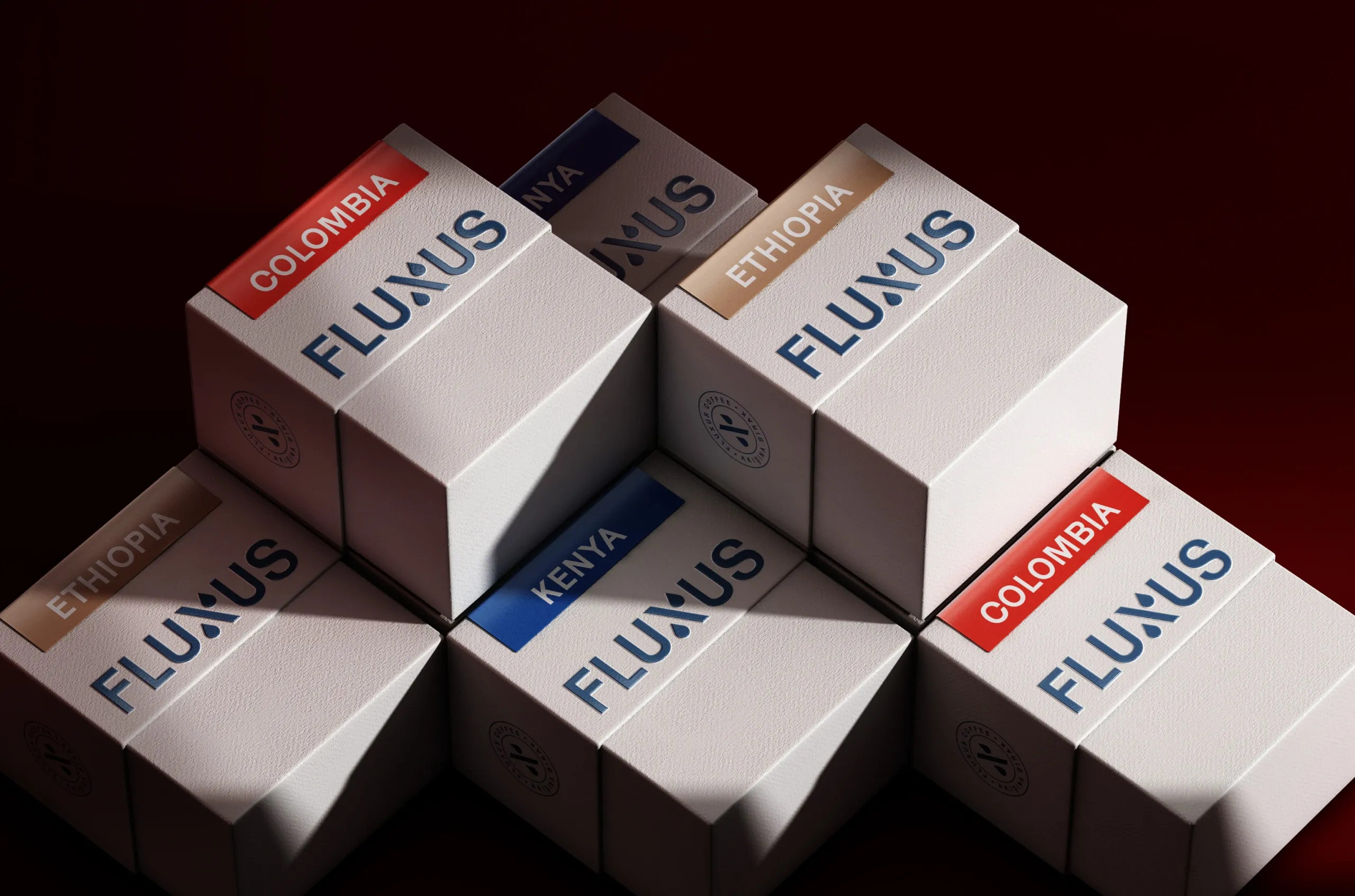
For Fluxus Coffee, the case study says: “We first created the identity for Fluxus Coffee in 2020. As the brand grew, its visual system needed to evolve with it.” The approach is stated directly: “We chose to return to the original identity and refine it rather than replace it. Everything that was still doing its job stayed.” The range was rebuilt so that “a new origin enters the system without a new design.” More of this work is in our coffee and tea branding case studies.
For Alici’s, a restaurant and lounge brand in London, the case study records an identity first developed in 2022 and evolved in 2026: “The existing wordmark and core geometric language were retained, while typography, colour, supporting graphics and applications were expanded into a more expressive system.”
In both cases the first decision was what to keep. To plan a rebrand around the packaging you already have, start from our contact page.
Questions brand owners ask about rebranding with printed stock
Do we need new barcodes when we rebrand?
It depends on what changes. GS1 states that a change to the primary brand on the trade item requires a new GTIN, and so does a change to the declared net content. Check each change against the GS1 rules.
Can we put a new brand sticker over old packaging?
Check it first. In the UK text of Regulation (EU) No 1169/2011, mandatory food information must not be hidden, obscured or interrupted by any other written or pictorial matter, so a sticker cannot cover it.
Is it a problem to have old and new packs on shelf together?
It works when the elements buyers use to find the product, such as the name, the variant colours and the information layout, stay fixed. The packs then read as 1 family during the change.
Should the new pack keep the same dieline?
Where the format still works, keeping the dieline avoids new tooling and lets old and new packs share the shelf. Change it only when the brief needs a new format.
Where should a rebrand plan start?
With a stock list: what is printed, where it is, what is on order and when each item runs out. The design schedule is then built backwards from those dates.
Count the printed stock, decide what must survive, check what the change triggers for barcodes and mandatory information, and phase the new pack in so old and new can sit together.
More brands we brought to life: