Compare branding proposals by putting them into 1 table with 6 rows: the strategy stage, the deliverables by name and count, the revision rounds, who owns the files and when, what is out of scope, and who does the work. Proposals that cannot fill a row have not named that part of the scope, and the price only means something once the rows match.
Put every proposal into the same 6 rows
Branding proposals do not follow a shared structure. 1 agency lists phases, another lists deliverables, a third describes an approach and attaches a total. Read side by side in that form, they compare only on the last line, which is the price.
The fix is to rebuild each proposal into 1 shared table before comparing anything. Our guide to choosing a packaging design agency puts the reason plainly: “A quote that names a price and a mood board has not named a scope.” Our guide to what a brand identity project includes gives the reading rule: “Scope varies by agency, so read a proposal for what it names rather than for what it promises.”
The table has 6 rows, and the rest of this article takes them in order:
- The strategy stage and what it produces.
- The deliverables, by name and count.
- The revision rounds, and what happens after them.
- Who owns the files, and when ownership transfers.
- What is out of scope.
- Who does the work, and who you will talk to.
A row a proposal cannot fill is a finding, not a gap to fill with a guess. Ask the agency to fill it in writing before you compare further.
Row 1: what the strategy stage produces
The strategy stage can be described at very different lengths. 1 proposal may give it a page of process; another a single line. The useful comparison is what it hands over at the end.
Our identity guide sets out the order on our own services list: “the first 5 are strategy: brand positioning, audience and persona analysis, naming and story building, brand voice and messaging, and competitor analysis. The mark comes sixth.” It also gives the reason the order matters: “A logotype drawn before the positioning is settled gets redrawn when the positioning changes, and the redraw is usually billed twice.”
For each proposal, write down whether strategy produces a written document, what that document contains, and whether the design stage is bound to it. Our guide to positioning a product brand lists the 4 decisions a positioning document should settle, which makes a useful checklist for this row.
If naming is included, note what checks come with it. GOV.UK’s trade mark search lets anyone “check if a similar trade mark to your brand already exists in the UK”. A proposal that includes naming should say whether that search, and its equivalent in other target markets, is part of the work or left to you.
Row 2: deliverables by name and count
This is the row where 2 proposals with similar totals turn out to describe different projects. Write each deliverable on its own line, with a count where one applies.
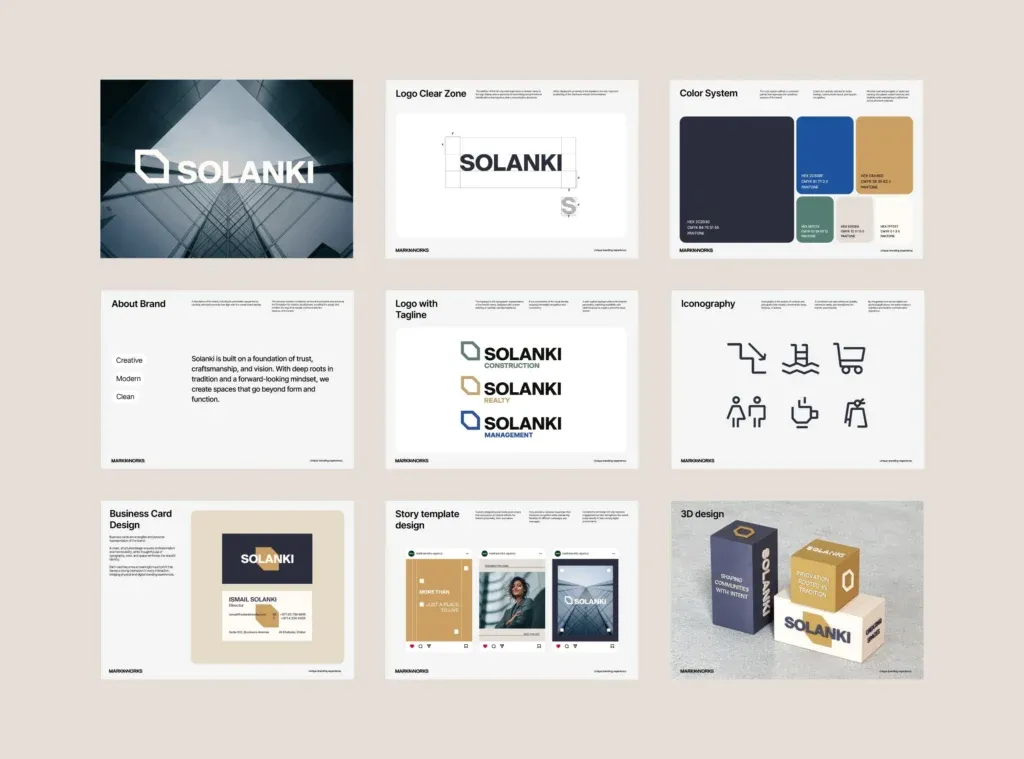
Our identity guide names the items to check: “how many packaging formats are included, whether digital templates are covered, whether 3D visualisation is part of the work, and who owns the source files at the end.” It also points to the phrase that hides most of the difference: our own list ends with “Brand Assets (business cards, templates, packaging, etc.)”, and “that ‘etc.’ is what to pin down before signing.”
Guidelines deserve a line of their own, because 2 different documents share the name. Our guide to questions to ask a branding agency says: “If the agency offers a lighter brand style guide as an alternative to full guidelines, ask which one is in the proposal, because they are different documents at different prices.”
For packaging projects, separate the presentation images from the production files. The packaging guide asks for a deliverables list that “covers dielines, print ready artwork and a named production review, not presentation images alone.” 2 proposals that both say “packaging design” can differ by exactly that line.
Row 3: revision rounds and what comes after
Revision terms decide how a project behaves when a design does not land at the first presentation. Compare 3 things: how many rounds are included, what counts as a round, and what happens after the last one.
A round can mean a full set of comments on 1 presentation, or each separate change request. A proposal that does not define the word leaves both sides to define it later, under pressure. Ask each agency to write the definition into the proposal.
The third part is easy to leave out. When the included rounds are used, does the project stop, move to an hourly rate, or continue within a fixed scope? None of these answers is wrong; the comparison only works when every proposal gives one.
The number of rounds also depends on how feedback is given. Clear feedback at each stage uses fewer rounds than scattered comments, and our guide to giving design feedback that moves a project forward covers how to write it. When comparing proposals, note whether the agency describes its review points, because fixed review points make rounds easier to count.
Row 4: who owns the files, in writing
Ownership is the row most often assumed and least often written down. Our packaging guide makes the same point about its own scope list: “The last item on that list is the one most often assumed and least often written down.”
The law in 2 common markets explains why the writing matters. In the UK, section 90 of the Copyright, Designs and Patents Act 1988 states: “An assignment of copyright is not effective unless it is in writing signed by or on behalf of the assignor.” In the US, 17 U.S. Code section 204 states that a transfer of copyright ownership “is not valid unless an instrument of conveyance, or a note or memorandum of the transfer, is in writing and signed by the owner of the rights conveyed or such owner’s duly authorized agent.”
For the comparison, note for each proposal: what is transferred (the final marks, the source files, the working files), when it transfers (on signature, on final payment, on delivery), and in what formats the files arrive. Our article on who owns the logo and design files sets out the first-owner rules in both countries. These are general rules; how they apply to a particular contract is a question for a lawyer, and the proposal stage is the right time to ask it.
Row 5: what is out of scope
An out-of-scope list is the clearest sign that an agency has thought about where the project ends. The packaging guide lists it as the final scope item: “What is out of scope, stated explicitly instead of by omission.”
Some items sit on the border and are worth asking about by name, because a proposal can be silent on them without being wrong: copywriting beyond headlines, photography and 3D renders, website build as opposed to design, printing and supplier management, additional packaging formats or sizes, translations for a second market, and trade mark filings.
Write each one into the table as included, excluded or priced separately. A proposal with a short out-of-scope list is not necessarily smaller; it may simply include more. A proposal with no list at all leaves each of those items to a later conversation.
Once row 5 is filled, the price line starts to mean something, because the proposals now describe the same project, or the differences between them are visible.
Row 6: who does the work, and who you talk to
The last row is about people. Our guide to questions for an agency puts the question directly: “Who exactly will do the design, and who will be your contact in the meetings.” It describes our own answer, “at MarkaWorks the designers stay at the desk and a project lead with strong communication skills runs the conversation”, and adds that other agencies put the designer in the room instead.
The same guide is clear that neither split is wrong: “what matters is that you know which one you are getting before the first meeting, and that all six answers arrive in writing.”
For the table, note the named roles: who leads the strategy stage, who designs, who reviews before anything reaches you, and who your single contact is. If the proposal names a specialist for packaging, 3D or web, note whether they work in-house or are contracted. Then compare timelines with the people in view, because a timeline is only as firm as the availability of the people named in it.
When the 6 rows are filled for every proposal, the table after this section shows what a complete answer looks like for each one.
| Row | Ask each agency | A complete answer contains |
|---|---|---|
| 1. Strategy | What does the strategy stage hand over? | A written document the design stage is bound to; naming checks if naming is included |
| 2. Deliverables | What exactly do we receive, and how many? | Each item by name and count; guidelines or style guide named; production files listed |
| 3. Revisions | How many rounds, what is a round, what happens after? | A number, a definition and the terms after the last round |
| 4. Ownership | What transfers, when, in which formats? | A written, signed transfer of the named files at a named point |
| 5. Out of scope | What is not included? | Border items listed as included, excluded or priced separately |
| 6. People | Who designs, who reviews, who is our contact? | Named roles, in-house or contracted, and a timeline that matches them |
How MarkaWorks writes its own proposals
MarkaWorks is a branding agency for product brands, and we write proposals so that they fill the 6 rows above. Our guide to questions for an agency states the commitment: “We publish the deliverable list item by item and put revision rounds, file formats and source-file ownership in writing before you sign.”
Our brand strategy and visual identity page describes the people side: “Each project draws on the specialists it needs, and all of them work in-house at MarkaWorks, so no part of the design work goes to outside contractors.” The same page describes the start of every project: “Tell us in a first call where the brand stands today, or ask for a written proposal; either way we come back with a suggested scope.”
If the project is an upmarket move for an existing brand, our article on repositioning a brand for a higher price point covers what the proposal should say about what stays. To get a proposal you can put into the table next to the others, start from our contact page.
Questions brand owners ask when comparing branding proposals
Why do branding proposals with similar prices differ so much?
Because they often describe different projects. Rebuild each proposal into the same 6 rows: strategy, deliverables, revisions, ownership, out of scope and people. The differences then become visible.
What should a proposal say about file ownership?
What transfers, when and in which formats. UK and US law both require a copyright transfer to be in writing and signed (the US rule excludes transfers by operation of law), so the contract should say it.
What counts as a revision round?
Whatever the proposal defines it as. Ask each agency to write the definition down, along with the number of rounds and what happens after the last one.
Is a longer out-of-scope list a bad sign?
Not necessarily. It shows where the project ends. A proposal with no list at all leaves those items to a later conversation.
Should the designer be in our meetings?
Either model can work. Some agencies put the designer in the room; at MarkaWorks a project lead runs the conversation. What matters is knowing which one you are getting, in writing.
Put every proposal into 1 table: the strategy stage, the deliverables by name and count, revision rounds, file ownership in writing, what is out of scope, and who does the work.
More brands we brought to life: